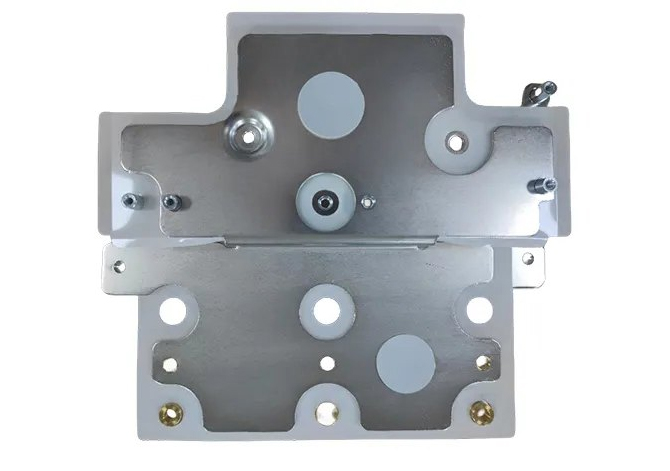
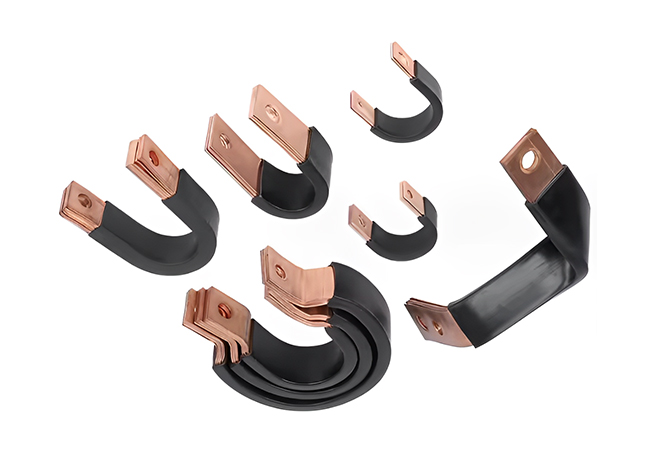
OEM Laminated Copper Bus Bar with Shunk Coating
√ Laminated construction ensures efficient power transmission.
√ Provides robustness and resistance to mechanical stress.
√ Withstands high temperatures without compromising performance.
√ Suitable for harsh environments, ensuring long-term reliability.
√ Available in various sizes, shapes, and configurations
The laminated copper bus bars we manufacture are constructed by bonding multiple layers of high-quality copper sheets with insulating layers in between. This construction ensures excellent electrical conductivity while providing insulation to prevent short circuits and electrical faults. Laminated copper busbar is a kind of power transmission component made of multiple layers of thin copper plates (or copper foils) and insulating materials alternately stacked by high temperature and high pressure process. Its core design optimizes the conductor structure to reduce the skin effect and improve the current-carrying capacity, while reducing the energy loss and material consumption, which is widely used in high-current and high-reliability power systems.
| Item type | Laminated copper bus bar |
|---|---|
| Material Standard | C11000 copper |
| Plating | tin-plating, nickle plating, silver plating |
| Single foil thickness | 0.05mm – 0.3mm |
| Insulated Coating | heat shrink tube |
| Dielectric strength: | 20kV/mm (PTFE insulation). |
| Thickness of plating | 3-5 μm |
Leading Laminated Copper Bus bar Manufacturer
We are the manufacturer of laminated copper bus bars, specializing in tailored solutions to meet a wide range of electrical and mechanical needs. Our cutting-edge factory is equipped with advanced technology and staffed by an experienced team, ensuring high-quality production and precise engineering. We serve various industries, delivering reliable and efficient bus bars that enhance both performance and safety.
Laminated copper bus bar Production Process:
Laminated copper busbars can be classified based on various factors such as size, shape, and configuration. Some common classifications include:
- Material Preparation: Copper foil/copper plate cut to required size, insulation material (e.g. epoxy resin film) cut.
- Lamination molding: Alternate stacking of copper and insulating layers, through the hot press high temperature (such as 200 ℃ ~ 300 ℃) and high pressure (such as 20MPa) curing.
- Welding and connection: Use molecular diffusion welding or pressure welding process to fix the contact surface.
- Surface treatment: Passivation treatment (anti-oxidation), tin/silver plating (enhance conductivity), epoxy coating (anti-corrosion).
- Bending and Testing: Specialized bending machine molding, and through the load capacity, voltage resistance, temperature rise and other tests.
Laminated copper bus bar advantages:
- High performance: Skin effect optimization, 53% increase in current-carrying capacity compared with solid copper rows, 10% to 20% reduction in loss.
- Light weight and environmental protection: Copper consumption is reduced by 30%~50%, in line with low-carbon requirements.
- Excellent heat dissipation: The multi-layer structure accelerates heat diffusion, and the temperature rise is 20% lower than that of traditional busbar.
- Compact structure: Compact size: 50% less space than cable, suitable for small environments (e.g. data centers).High reliability:
- High reliability: vibration-resistant, short-circuit-resistant (63kA/4s), with a life span of more than 20 years.
Laminated copper bus bar application:
- Power system: Substation main busbar, distribution cabinet busbar.
- New energy: PV/wind farm power transmission, electric vehicle battery pack connection.
- Industrial equipment: High-current equipment such as frequency converters, welding machines, machine tools, etc.
- Rail transportation: High-speed rail/subway power system, signaling system power supply.
- Data Center: Efficient power distribution for server clusters.
Laminated copper busbars FAQ
Q1: What is the difference between laminated copper busbar and traditional copper busbar?
A1: Laminated structure reduces the skin effect through thin copper plate stacking, higher current carrying capacity, lower loss, and lighter weight.
Q2:What are the advantages of flexible laminated busbar?
A2: It can be bent and installed to adapt to the complex space, and can compensate for equipment installation errors, suitable for electric vehicle charging pile and other scenarios.
Q3:How to choose the insulation material of laminated busbar?
A3: Choose according to the temperature demand, such as PTFE (high temperature resistant), epoxy resin (high mechanical strength) or silicone rubber (flexible).
Q4: Key points for quality control in production?
A4:Copper purity (≥99.95%), lamination uniformity, welding strength and insulation layer dielectric properties need to be tested.
Q5: Is laminated busbar suitable for outdoor environment?
A5: Yes. With IP67 protection design and UV-resistant coating, it can adapt to humid, dusty and other harsh conditions.
For more detailed technical parameters or customized solutions, please contact our team.

 English
  Arabic
  German
  Spanish
  French
  Russian
  Danish
  Japanese
  Italian
  Vietnamese
  Turkish
  Dutch
Dutch  Portuguese
  Thai
Thai  Swedish
  Korean
  Greek
Greek  Polish
  Estonian
  Esperanto
  Hindi
Hindi  Indonesian
  Latvian