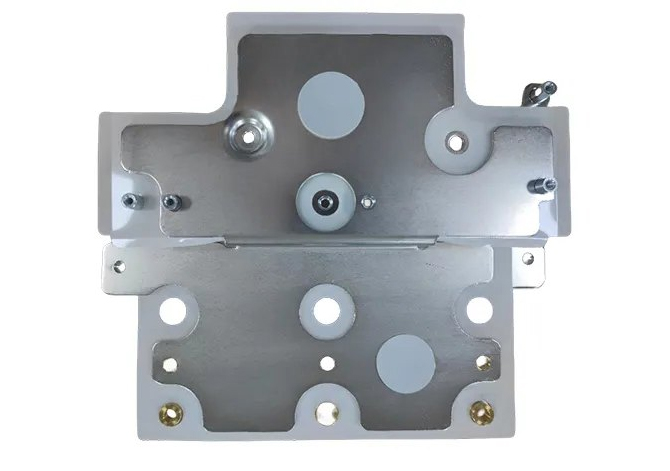
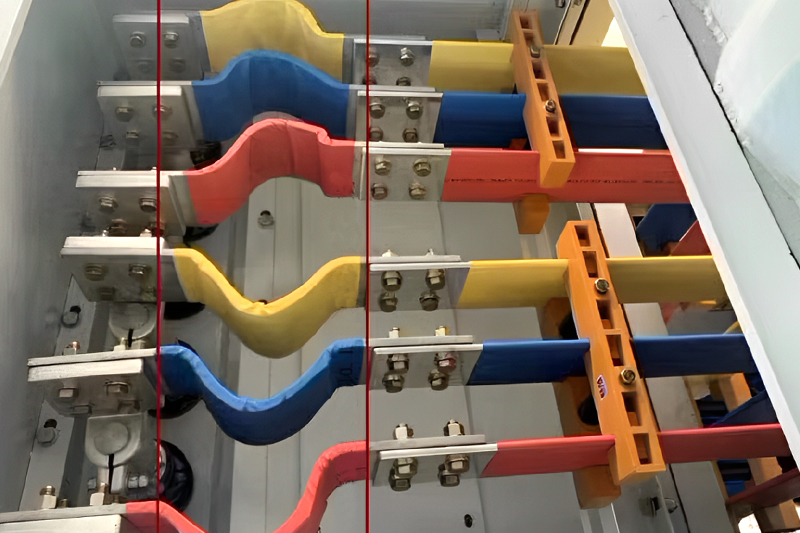
As an indispensable conductive material in modern industry, copper busbar plays a core role in power transmission, electronics manufacturing, new energy, and other fields by virtue of its excellent conductivity and unique physical properties. This paper analyzes the conductive mechanism, thermodynamic properties, and industrial application scenarios of copper busbar through 10 groups of key data, combined with research data from international authorities, revealing how this metal component supports the efficient operation of the modern industrial system.
6 functions of copper Busbars
- Superconducting current transfer capability
IEC 60468 data show that the electrical conductivity of copper (58.0×10^6 S/m) is 1.6 times that of aluminum, and it can carry a higher current density under the same cross-sectional area. Typical application example: Tesla Supercharger uses 0.6mm thick copper busbars to realize 480A current transmission (Source: IEEE Transactions on Industry Applications). - Highly efficient heat transfer system
The thermal conductivity of copper (401 W/m-K) is 8 times higher than that of steel, and with the corrugated design, it can improve the heat dissipation efficiency by 30%. Siemens research shows that the use of copper busbars in transformers can reduce the temperature rise by 15-20℃ (Source: Siemens Technical Report 2022). - Corrosion-resistant protection system
ASTM B152 standard provides that copper busbars containing ≥ 99.9% copper can remain corrosion-free for 2000 hours in the salt spray test. Japan’s JIS H0505 certification data show that the special tin-plating process can extend the service life to 30 years (case: Tokyo Electric Power submarine cable project). - Electromagnetic shielding barrier
Thickness of 0.3mm copper busbars can realize 40dB electromagnetic shielding effect, effectively suppressing 50-100MHz frequency band interference. - Mechanical support structure
The tensile strength of C1100 copper busbars treated by cold rolling process can reach 350MPa, and the bending radius can be as low as 0.5 times of the plate thickness.
| Material Type | Tensile Strength (MPa) | Bending Radius Factor |
|---|---|---|
| Pure Copper busbar | 220-350 | 0.5-1.0t |
| Aluminum alloy busbar | 120-200 | 1.5-2.0t |
- Environmentally friendly recyclable characteristics
International Copper Association statistics show that the energy consumption of recycled copper busbar production is only 15% of virgin copper, and the global copper recycling rate has reached more than 60%.
How is Working principle of copper busbars?
- Electron Migration Theory
The free electron density in copper crystals reaches 8.5×10^28/m³, and the migration speed reaches 0.1mm/s under an electric field of 1V/m. - Skin effect control
The silver plating process is used for high-frequency applications, which can raise the upper operating frequency limit from 10kHz to 2MHz. - Thermodynamic conduction modeling
Through ANSYS simulation analysis, optimizing the cross-sectional shape of copper busbars can increase the uniformity of heat flow density distribution by 40%.
What are the application scenarios?
- New energy power generation system
Photovoltaic inverters use 3-5kg/kW of copper, and wind power converters use multi-layer stacked sheet design to reduce inductance by 30% . - Electric Vehicle Power System
Ningde Times Battery Pack solution shows that shaped copper busbars reduce connection impedance to 0.2mΩ and increase energy efficiency by 1.2% - Data Center Power Distribution Architecture
Google’s fourth-generation data centers use 0.8mm thick copper busbars to achieve a PDU power density of 50kW/rack and reduce losses to 0.5% . - Industrial automation control
ABB motor drives use a segmented copper busbar design to reduce dv/dt noise by 15dB, complying with IEC 61800-3 (Technical Document: ABB Drives Technical Guide). - Aerospace electronics
Boeing 787 power supply network adopts nickel-plated copper busbars, maintaining contact resistance <5μΩ under operating conditions from -55℃ to 125℃ .
Industry Trend Outlook
According to Grand View Research, the global copper busbar market will expand at a CAGR of 6.8% from 2023-2030, with demand in the new energy vehicle sector growing at a rate of 12.4%. Breakthroughs in nanocrystalline copper materials are expected to increase the conductivity to 105% IACS .
Conclusion
From microelectronic circuits to gigawatt-scale transmission systems, copper busbar has always been a physical carrier for the efficient transmission of electrical energy. With advances in materials engineering and interdisciplinary applications, this ancient metallic conductor is taking on new life in emerging fields such as smart grids and quantum computing. Choosing high-quality copper conductor products that comply with the IEC 61238 standard will become a key decision in ensuring the reliability of power systems.
.
| Material Type | Tensile Strength (MPa) | Bending Radius Factor |
|---|---|---|
| Pure Copper busbar | 220-350 | 0.5-1.0t |
| Aluminum alloy busbar | 120-200 | 1.5-2.0t |
Environmentally friendly recyclable characteristics
- International Copper Association statistics show that the energy consumption of recycled copper busbar production is only 15% of virgin copper, and the global copper recycling rate has reached more than 60%.
How is Working principle of copper busbars?
- Electron Migration Theory
The free electron density in copper crystals reaches 8.5×10^28/m³, and the migration speed reaches 0.1mm/s under an electric field of 1V/m. - Skin effect control
The silver plating process is used for high-frequency applications, which can raise the upper operating frequency limit from 10kHz to 2MHz. - Thermodynamic conduction modeling
Through ANSYS simulation analysis, optimizing the cross-sectional shape of copper busbars can increase the uniformity of heat flow density distribution by 40%.
What are the application scenarios?
- New energy power generation system
Photovoltaic inverters use 3-5kg/kW of copper, and wind power converters use multi-layer stacked sheet design to reduce inductance by 30% . - Electric Vehicle Power System
Ningde Times Battery Pack solution shows that shaped copper busbars reduce connection impedance to 0.2mΩ and increase energy efficiency by 1.2% - Data Center Power Distribution Architecture
Google’s fourth-generation data centers use 0.8mm thick copper busbars to achieve a PDU power density of 50kW/rack and reduce losses to 0.5% . - Industrial automation control
ABB motor drives use a segmented copper busbar design to reduce dv/dt noise by 15dB, complying with IEC 61800-3 (Technical Document: ABB Drives Technical Guide). - Aerospace electronics
Boeing 787 power supply network adopts nickel-plated copper busbars, maintaining contact resistance <5μΩ under operating conditions from -55℃ to 125℃ .
Industry Trend Outlook
According to Grand View Research, the global copper busbar market will expand at a CAGR of 6.8% from 2023-2030, with demand in the new energy vehicle sector growing at a rate of 12.4%. Breakthroughs in nanocrystalline copper materials are expected to increase the conductivity to 105% IACS .
Conclusion
From microelectronic circuits to gigawatt-scale transmission systems, copper busbar has always been a physical carrier for the efficient transmission of electrical energy. With advances in materials engineering and interdisciplinary applications, this ancient metallic conductor is taking on new life in emerging fields such as smart grids and quantum computing. Choosing high-quality copper conductor products that comply with the IEC 61238 standard will become a key decision in ensuring the reliability of power systems.
.
Related Post
Why can’t a copper busbar and an aluminum busbar be directly connected?
[email protected]2025-12-08T02:54:03+00:00December 8th, 2025|0 Comments
Introduction Copper busbars and aluminum busbars are the two most commonly used conductive materials in the field of power systems and industrial distribution. Due to differences in cost, resource availability, and technical requirements, they often
How to Prepare for a Big Win at Tez888 Casino
Developer Ismail2025-10-04T21:44:04+00:00October 4th, 2025|0 Comments
When aiming for a significant payout at Tez888 casino, one crucial step often overlooked is thorough receipt checking and verification. Properly managing your transaction records not only ensures transparency but also plays a vital role
Tips and Tricks for Successful Betting on Bettilt
Developer Ismail2025-08-17T05:29:18+00:00August 17th, 2025|0 Comments
When engaging in online betting, particularly on platforms like bettilt, it's crucial to incorporate strategies such as receipt checking, tax optimization, and thorough verification to maximize your success. These elements ensure that your betting activities

How Do You Calculate the Size of a Copper Busbar?
[email protected]2025-06-06T06:54:57+00:00June 6th, 2025|0 Comments
1. Introduction to Busbar Sizing Accurate copper busbar sizing is vital for secure, dependable, and effective electric circulation. Busbars disperse high currents in switchgear and panelboards. Inappropriate sizing reasons extreme warmth, power loss, voltage
10 Essential Tips for Working with Copper Busbars
[email protected]2025-06-03T06:35:28+00:00June 3rd, 2025|0 Comments
In modern power systems, copper busbars have actually become a core element in power transmission and distribution because of their superb electric conductivity, rust resistance and mechanical strength. As a specialist manufacturer of copper
A Guide to Maintaining Copper Busbars Effectively
[email protected]2025-05-28T06:09:36+00:00May 28th, 2025|0 Comments
As a core component of power transmission systems, copper busbars are an important choice for industry due to their high electrical conductivity, corrosion resistance and mechanical strength. However, the durability of its performance is
Get IN TOUCH
We Deliver Any Customize Busbars
Related Posts
Nam lacinia arcu tortor, nec luctus nibh dignissim eu nulla sit amet maximus.

Nam lacinia arcu tortor, nec luctus nibh dignissim eu nulla sit amet maximus.
Nam lacinia arcu tortor, nec luctus nibh dignissim eu nulla sit amet maximus.
Nam lacinia arcu tortor, nec luctus nibh dignissim eu nulla sit amet maximus.

 English
  Arabic
  German
  Spanish
  French
  Russian
  Danish
  Japanese
  Italian
  Vietnamese
  Turkish
  Dutch
Dutch  Portuguese
  Thai
Thai  Swedish
  Korean
  Greek
Greek  Polish
  Estonian
  Esperanto
  Hindi
Hindi  Indonesian
  Latvian