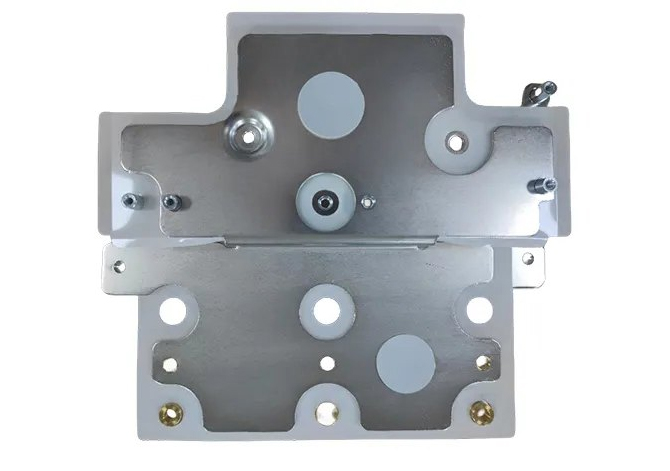
In the field of electrical engineering, a copper busbar is a key conductive element; its surface treatment process directly affects the performance and life of the equipment. Tinned copper busbars and non-tinned copper busbars are due to different treatment methods; in terms of conductivity, corrosion resistance, cost, and application scenarios, there are significant differences. This paper analyzes the five core indicators (conductivity, corrosion resistance, temperature rise control, economic cost, and application scenarios), combined with authoritative data and industry cases, for engineering design and selection to provide a scientific basis.
Difference in conductivity
- Conductivity differences
Pure copper has a resistivity of 1.7×10⁻⁸ Ω-m, while tin has a resistivity of up to 2.2×10⁻⁷ Ω-m. Although tin plating slightly increases the overall resistance of the copper busbars, the advantage lies in its long-term stability.
| Material Type |
Resistivity (Ω-m) |
Electrical Conductivity (IACS) |
| Pure Copper |
1.7×10⁻⁸ |
100% |
| Tinned Copper |
|
97% |
The tinned layer prevents oxidization of the copper substrate and avoids resistance surges due to the formation of copper green (copper alkali carbonate).
- Contact resistance optimization
Tin-plated copper busbars have a smooth and uniform surface, and the contact resistance is reduced by about 15-20% compared to ordinary copper busbars . For example, in photovoltaic inverter connection, the tin-plating treatment reduces the temperature rise at the contact point by 8-10K, which significantly improves the system efficiency.
Difference in Corrosion Resistance
- Oxidation protection mechanism
Ordinary copper busbars in environments with humidity > 60% will produce a visible oxidation layer within 48 hours; tinned copper busbars with a tin layer can be isolated from oxygen and moisture, slowing down the oxidation process 3-5 times. For example, after adopting tinned copper busbars in coastal substations, the maintenance cycle has been extended from 1 year to 3 years.
- Acid and alkali environment resistance
In a pH 3-11 acid and alkali environment, the corrosion rate of tinned copper busbar is only 1/4 of that of ordinary copper busbar.
- Comparison of corrosion rate in different environments.
| Environment type |
in-plated copper busbars (mm/year) |
Pure copper busbars (mm/year) |
| Coastal Salt Spray |
0.003 |
0.015 |
| Industrial acid rain (pH4) |
0.002 |
0.008 |
Difference in temperature
- Temperature rise standard difference
According to the national standard GB/T 14048.1, the allowable temperature rise of tin-plated copper busbar is 65K, which is higher than that of ordinary copper busbar, which is 50 K. This characteristic makes it possible to increase the carrying capacity by about 10%-15% under the same cross-sectional area.
- Thermal stability advantage
Tin plating layers can evenly distribute current density, reducing the risk of local overheating. For example, after a data center bus duct used tinned copper busbars , the peak temperature rise dropped from 75K to 62K, and the system failure rate dropped by 40%.
Application scenarios
- Tin-plated copper busbar of applicable fields
- High humidity environments, such as coastal power stations and ship electrical systems
- Precision electronics: semiconductor packaging, 5G base station
- High-frequency scenarios: new energy inverters, high-speed rail traction systems.
- The economic choice of ordinary copper busbars
- Dry indoor environments, such as commercial building distribution cabinets (national standard GB50303-2015 allows non-tin-plated treatment).
- Short-term projects: temporary power supply facilities, low-cost equipment.
Conclusion
The choice between tin plated copper conductors requires a combination of conductive requirements, environmental conditions, budget, and maintenance costs. In corrosive environments or high-reliability scenarios, tinned copper busbars have become the first choice due to their stable conductivity and long-lasting protection, while in dry, low-load conventional scenarios, ordinary copper busbars still have cost advantages. In the future, with the optimization of the tin-plating process (such as nano-coating technology), its cost-effective advantage will be further highlighted.




 English
  Arabic
  German
  Spanish
  French
  Russian
  Danish
  Japanese
  Italian
  Vietnamese
  Turkish
  Dutch
Dutch  Portuguese
  Thai
Thai  Swedish
  Korean
  Greek
Greek  Polish
  Estonian
  Esperanto
  Hindi
Hindi  Indonesian
  Latvian