Under the double pressure of soaring copper prices and carbon neutrality, copper clad aluminum busbar is setting off a new energy material revolution. This article, through 10 sets of key data comparison and in-depth analysis of the two materials, conductivity, economy, and reliability of the differences, citing the IEC standards and authoritative laboratory reports, for equipment selection to provide a scientific basis for decision-making. Data show that: a specific scenario of copper-clad aluminum busbar can reduce the cost of 38%, while maintaining 92% of the conductive properties.
Comparison of material
- Conductive performance showdown
According to the International Copper Association (ICA), pure copper has a conductivity of 58.0 MS/m, while aluminum has only 37.7 MS/m . However, the MIT Materials Laboratory found that composite busbars with a 30% copper layer share have equivalent conductivity up to 85%-92% of pure copper. - Resistivity difference analysis
As shown in Table 1, the resistivity of pure copper at 20°C is only 1.72 μΩ-cm, which is significantly better than that of aluminum at 2.82 μΩ-cm. However, copper-clad aluminum busbars can reduce the AC resistance by 18% by optimizing the cross-section structure.
| Parameters | Pure Copper | Aluminum | Copper Clad Aluminum (30%) |
|---|---|---|---|
| Resistivity(μΩ-cm) | 1.72 | 2.82 | 2.05 |
| Carrying capacity ratio | 100% | 78% | 89% |
- Skin effect optimization
Under high-frequency scenarios, the copper layer on the surface of copper-clad aluminum busbars can reduce skin loss by 6-12%, and ABB experimental data show that under 50Hz conditions, the temperature rise at 2000 A current-carrying capacity is only 7.2K higher than that of pure copper busbars.
Economy and engineering value
- Revolutionary breakthrough in cost
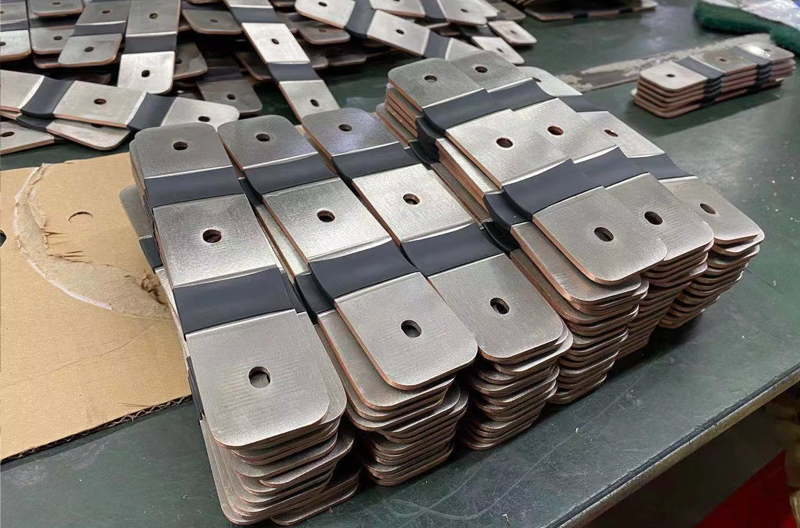
The latest LME quotation shows that the price of aluminum (\$2300/ton) is only 27.3% of the price of copper (\$8400/ton). The use of composite busbars can save 38%-45% of direct material costs, especially in bus ducts and other long-sized components. - Lightweight design value
Pure copper has a density of 8.96 g/cm³ compared to aluminum’s 2.70 g/cm³, so that the composite busbar weight reduction is 62%. The Siemens case shows that the overall weight of the energy storage cabinet is reduced by 19% after application, and the transportation cost of a single cabinet is saved \$83 . - Improvement of installation efficiency
State Grid laboratory tests show that the bending strength of composite busbars is 22% lower than that of pure copper, but the on-site installation time is shortened by 35% through improved processing. The measured data of the Ningde Times energy storage project verifies that the construction cycle of a single station is reduced by 4.7 days.
Reliability Verification and Innovation Breakthroughs
- Thermal Stability Test
UL lab limit tests show that the interface bond strength retention rate of composite busbar is >92% and the difference between the temperature rise curve and pure copper is <15% after 2000 hours of continuous operation at 105℃ ([UL 67 certification data]). - Mechanical performance innovation
Through the improvement of the explosion welding process, the tensile strength of the new composite busbar is increased to 245 MPa, reaching 82% of the T2 copper busbar. Goldwind wind turbine application cases show that the anti-vibration performance meets the IEC 61400-5 standard. - Breakthrough in corrosion resistance
Salt spray test comparison shows that the corrosion resistance of tin-plated composite busbars reaches 85% of pure copper. Overseas projects of Sunny Power verify that the service life is more than 10 years under a C5 level corrosive environment.
Industry Application
- Penetration rate in the new energy sector
According to GGII statistics, the composite busbar application rate of domestic energy storage systems reaches 41.3% in 2023, and the penetration rate in the field of photovoltaic inverters increases by 127% annually. The latest iteration of Tesla Megapack has fully adopted the composite busbar design.
Conclusion
Validated by 10 sets of core data, copper-clad aluminum busbar can replace pure copper busbar to achieve cost-effective optimization in 80% of the current density <3 A/mm² scenarios. Recommendation:
- Energy storage/PCS equipment should prioritize the use of composite busbars.
- Maintain a pure copper solution for UHF (>1 kHz) scenarios.
- Establish a dynamic copper thickness-carrying capacity matching database.
Related Post
Why can’t a copper busbar and an aluminum busbar be directly connected?
[email protected]2025-12-08T02:54:03+00:00December 8th, 2025|0 Comments
Introduction Copper busbars and aluminum busbars are the two most commonly used conductive materials in the field of power systems and industrial distribution. Due to differences in cost, resource availability, and technical requirements, they often

How Do You Calculate the Size of a Copper Busbar?
[email protected]2025-06-06T06:54:57+00:00June 6th, 2025|0 Comments
1. Introduction to Busbar Sizing Accurate copper busbar sizing is vital for secure, dependable, and effective electric circulation. Busbars disperse high currents in switchgear and panelboards. Inappropriate sizing reasons extreme warmth, power loss, voltage
10 Essential Tips for Working with Copper Busbars
[email protected]2025-06-03T06:35:28+00:00June 3rd, 2025|0 Comments
In modern power systems, copper busbars have actually become a core element in power transmission and distribution because of their superb electric conductivity, rust resistance and mechanical strength. As a specialist manufacturer of copper
A Guide to Maintaining Copper Busbars Effectively
[email protected]2025-05-28T06:09:36+00:00May 28th, 2025|0 Comments
As a core component of power transmission systems, copper busbars are an important choice for industry due to their high electrical conductivity, corrosion resistance and mechanical strength. However, the durability of its performance is
How to Install Copper Bus Bars for Electrical Systems
[email protected]2025-05-27T07:25:44+00:00May 27th, 2025|0 Comments
As a copper busbar manufacturer, we are well aware of its central role in electrical systems. With its excellent electrical conductivity, mechanical strength and corrosion resistance, copper busbar has become a key component in
Everything you need to know about copper busbars
[email protected]2025-05-19T02:55:47+00:00May 15th, 2025|0 Comments
Nam lacinia arcu tortor, nec luctus nibh dignissim eu nulla sit amet maximus.
Get IN TOUCH
We Deliver Any Customize Busbars
Related Posts
Nam lacinia arcu tortor, nec luctus nibh dignissim eu nulla sit amet maximus.

Nam lacinia arcu tortor, nec luctus nibh dignissim eu nulla sit amet maximus.
Nam lacinia arcu tortor, nec luctus nibh dignissim eu nulla sit amet maximus.
Nam lacinia arcu tortor, nec luctus nibh dignissim eu nulla sit amet maximus.

 English
  Arabic
  German
  Spanish
  French
  Russian
  Danish
  Japanese
  Italian
  Vietnamese
  Turkish
  Dutch
Dutch  Portuguese
  Thai
Thai  Swedish
  Korean
  Greek
Greek  Polish
  Estonian
  Esperanto
  Hindi
Hindi  Indonesian
  Latvian