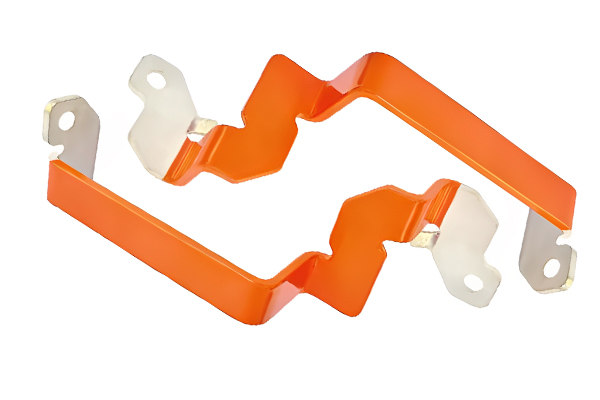
Epoxy pulverlakeret samleskinneisolering
√ Epoxybelægning tilføjer et beskyttende lag for at øge skinnens levetid.
√ Sikrer ensartet isolering og minimerer elektriske kortslutninger.
√ Giver ensartet dækning, hvilket sikrer ensartet isolering.
√ Belægningen sikrer ensartet isolering og minimerer elektriske kortslutninger.
Epoxy powder coated busbar insulation provides enhanced durability and excellent corrosion resistance, ensuring a long lifespan even in harsh environments. . The structure consists of a metallic conductor covered with multiple layers of insulating material, which enables safe transmission of large currents and high voltages by optimizing electric field distribution and insulation protection. The following is a detailed explanation of its key features and classification:
| Varetype | Epoxy pulverlakeret samleskinneisolering |
|---|---|
| Materiale standard: | Epoxy pulverlakering på kobber eller aluminium skinner. |
| Isolering: | Epoxy pulver |
| Samleskinne tykkelse: | 2 mm, 3 mm eller tilpasset |
| plettering: | tin/nikkel/sølv/andet |
| Dielektrisk styrke: | Varierer typisk fra 20 kV/mm til 40 kV/mm |
| V modstand: | UV-bestandig for at forhindre nedbrydning i udendørs applikationer, testet i henhold til ASTM G154. |
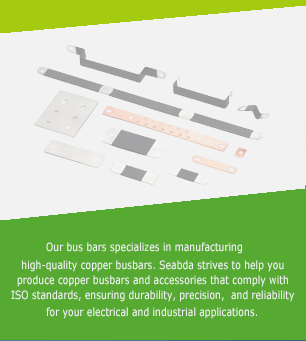
Førende producent af epoxy pulverlakeret samleskinneisolering
Som en førende producent af epoxy-pulverlakeret skinneisolering tilbyder vi løsninger, der sikrer øget holdbarhed, overlegen korrosionsbestandighed og ensartet isolering. Vores samleskinner er designet til at give pålidelig ydeevne i barske miljøer og kan tilpasses i forskellige farver for nem identifikation og organisering. Kontakt os i dag for at opleve fordelene ved vores skræddersyede skræddersyede skinneisoleringsløsninger af høj kvalitet.
What are the types for insulated busbar?
Wrap-around insulated busbar
Use polyester film or PTFE tape to wrap the conductor layer by layer, and add aluminized film capacitor screen. The disadvantage is that the winding process is prone to residual air gaps, resulting in a higher risk of partial discharges and poorer reliability.
Extruded Insulated Busbar
Extruded EPDM rubber insulation layer on the surface of the conductor, simple process, but easy to crack when bending, uneven electric field distribution at the end (only two layers of capacitive screen), easy to trigger flashover.
Epoxy cast insulated busbar
Vacuum impregnated epoxy resin curing molding, insulation layer without air gap, the end of the use of variable screen distance equalization pressure, the best pressure resistance, is currently the highest reliability of the type.
Composite Shielded Tubular Busbar
Combined shielding and fully enclosed insulation, protection level up to IP55, suitable for outdoor and highly polluted environments, modular design for easy installation.
What are the advantages for insulated busbar?
- High current-carrying capacity: Hollow conductor reduces AC resistance (45% less than rectangular busbar), temperature rise ≤30K.
- Highly efficient heat dissipation: Hollow structure natural ventilation heat dissipation, temperature rise is 60% lower than traditional cables.
- Convenient installation: modular design reduces the number of supporting parts, span up to 13 meters, and strong seismic performance (can withstand a magnitude 7 earthquake).
- Full insulation protection: zero potential on the outer surface, supports compact arrangement (phase spacing only needs to meet mechanical installation requirements).
Whare are the application for insulated busbar?
- Electric power system: transformer and switchgear connection in substation and distribution station, extra-high voltage transmission project.
- New energy: collector lines of photovoltaic power stations and wind farms, insulation protection of energy storage systems.
- Industry and construction: high-voltage power distribution of iron and steel plants, vertical power transmission trunk lines of high-rise buildings.
- Rail transportation: subway, high-speed rail traction power supply system.
Hvor tyk er epoxybelægningen på en samleskinne?
The epoxy coating thickness of busbars should be customized according to the specific application scenarios:
- High voltage (≥15kV): 1.5-3.2mm;
- Medium voltage scenario (10kV): 0.3-0.5mm;
- Low-voltage anticorrosion scenario: 80-120μm (general standard) or 0.3-0.5mm.
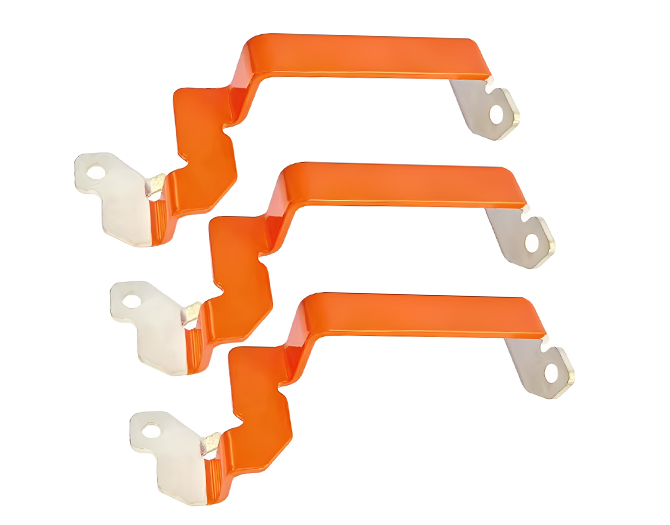
Hvordan isolerer man en samleskinne?
Isolering af en samleskinne involverer flere metoder til at sikre, at den er ordentligt beskyttet mod elektriske fejl og miljøfaktorer. Her er nogle almindelige metoder til at isolere en samleskinne:
1. Physical isolation structure design
- Separation of independent compartments: High-voltage switchgear completely isolates the busbar compartment from the cable compartment by means of metal partitions, forming an independent sealed space. Example: The busbar compartment is located in the upper part of the cabinet, and the cable compartment is in the lower part. The two are separated by metal partitions and insulated dividers to ensure that the distance between phases/to ground is ≥30mm (12kV scenario).
- Advantage: Blocking the arc spreading path, reducing the risk of fault spreading.
2. Insulation material cladding technology
a. Heat-shrinkable/cold-shrinkable sheath:
- Heat-shrinkable sheath: shrink wrapping busbar by heating, easy to operate but there are aging problems (temperature resistance ≤ 125 ℃), and affect the heat dissipation.
- Cold Shrink Sheath: No need to heat, but the cost is higher, suitable for complex shapes of busbars.
- Typical application: Rekan BPTM heat shrinkable sleeving can reduce the air clearance of 12kV busbar to 65mm.
b. Epoxy powder coating:
- Process: Fluidized bed dip coating or electrostatic spraying, copper rows preheated to 180-240 ℃ after adsorption of epoxy powder, curing to form a dense insulating layer (thickness of 1.5-3.2mm, high-voltage scenario).
- Performance: breakdown strength ≥37kV/mm, temperature resistance up to 180℃, volume resistance >1×10¹⁸Ω-cm.
- Advantage: can reduce the distance between phases (e.g. 220mm for bare row → 200mm after coating), suitable for complex shape busbar.
3. Gas insulation technology
a. SF6 gas filling:
Filling 0.04MPa SF6 gas in the sealed busbar compartment to improve insulation performance (3 times the pressure strength of air) and no need for routine maintenance.
- Application scenario: High-voltage gas-filled cabinets (C-GIS), suitable for humid and dirty environments. Limitations: Complicated sealing process, no need for routine maintenance.
- Limitations: Complicated sealing process and greenhouse effect of SF6 gas.
b. Micro-positive pressure dry air protection:
The inside of the closed busbar is filled with dry clean air (pressure 300-2500Pa), forming an air seal to prevent moisture intrusion. For example, the busbar pressure preservation time is ≥15 minutes (national standard requirement).
- Supporting technology: micro-positive pressure device automatically replenishes air, used with sealing rubber strips to improve insulation stability.
4. Multi-layer composite insulation process
– Multi-split busbar structure:
Adopt the combination of layered insulation + semi-conductive layer + metal sheath:
1. spraying semi-conductive layer on the surface of the conductor (to eliminate electric field distortion);
2. Covering the main insulation layer (e.g. cross-linked polyethylene). 3;
3. metal grounding sheath (copper tape or welded aluminum tube).
– Example: Multi-split tubular busbars with multiple layers of insulation and conductive layers by rolled and welded process, up to 3,150 A current-carrying capacity.
– Dynamic insulation regulation:
In low-temperature environments, the on/off switching of split conductors (e.g., switching the core and conductive layer power supply when the temperature is <4°C) prevents ice overlay.
5. Process optimization and testing
Coating process selection:
- Fluidized bed dip coating: suitable for mass production, uniform coating (North American standard IEEE C37.20.2 mandatory requirements).
- Electrostatic spraying: suitable for complex shapes busbar, powder utilization rate >95%.
Key testing indicators:
- Voltage withstand test: e.g. 2mm epoxy coated busbar withstand 50kV/1min I.V. when cross-crossed.
- Sealability verification: Confirmation of airtightness by holding pressure test (2500Pa→300Pa time consuming ≥15 minutes).

 Danish
  English
  Arabic
  German
  Spanish
  French
  Russian
  Japanese
  Italian
  Vietnamese
  Turkish
  Dutch
Dutch  Portuguese
  Thai
Thai  Swedish
  Korean
  Greek
Greek  Polish
  Estonian
  Esperanto
  Hindi
Hindi  Indonesian
  Latvian