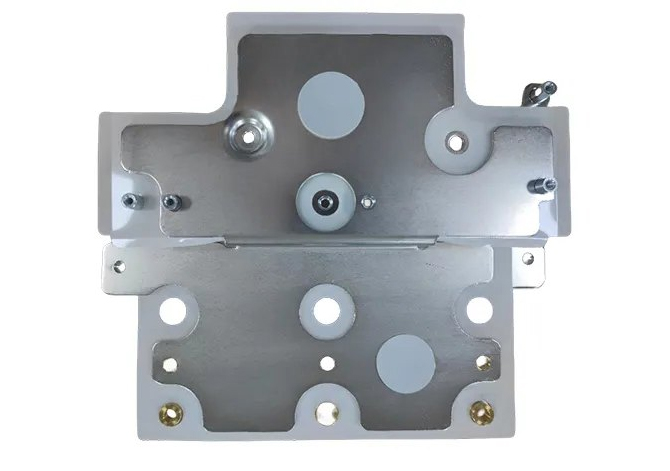
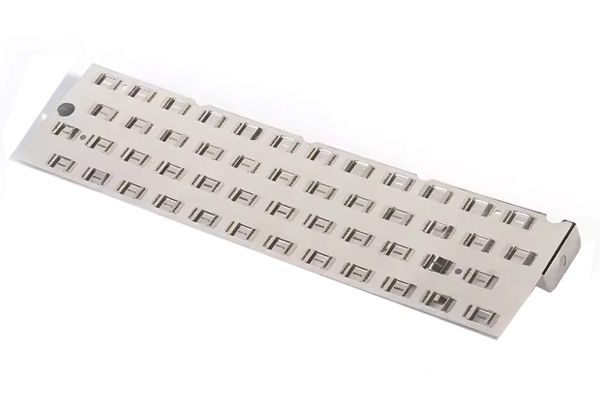
La Propra Spot Welding Battery Bus-bar Konektilo estas adaptita por elektraj veturiloj (EV) aplikoj, ligante ĉelojn per altnivelaj punktaj veldaj teknikoj. Faritaj el altpura kupro aŭ nikel-tegita kupro, ĉi tiuj konektiloj ofertas superan elektran konduktivecon, minimuman reziston kaj plifortigitan fortikecon.
| Item Tipo: | Bateria Bus-stango Konektilo |
|---|---|
| Materiala bazo: | Altpura kupro aŭ nikel-tegita kupro |
| Tegaĵo: | Laŭvola nikela tegaĵo |
| Funkcia temperaturo: | -40 °C ĝis +125 °C |
| Solda Tipo: | Punkta veldado |
| Ĉela Kongrueco: | Taŭga por cilindraj kaj prismaj bateriĉeloj uzitaj en EVs |
| Nuna Kapacito: | Agordigebla surbaze de aplikaj postuloj |
| Dikeco: | Agordigebla (norma gamo: 0,5 mm ĝis 2,5 mm) |
| Larĝo: | Agordigebla |
| Longo: | Agordigebla |
| Surfaca Finaĵo: | Glata finaĵo por fidinda veldado kaj elektra rendimento |
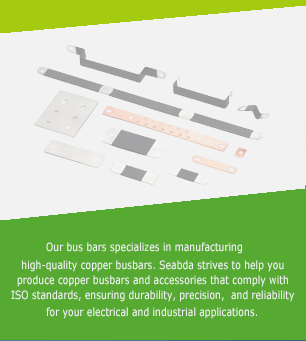
Ĉefa Propra Bateria Bus-stango Konektilo Fabrikisto
We use a composite process of laser spot welding and ultrasonic welding, which reduces the connection resistance to less than 0.15 mΩ. The lower buffer structure can increase the stress dispersion efficiency of the welding point by 40%, and the cycle life exceeds 5,000 times of charging and discharging tests. The technology has been applied to the 150 kWh solid-state battery pack of the Azalea ET7, realizing the temperature difference of the single cell to be controlled at ±1.5℃.
Cross-border integration of material science. The use of high-purity oxygen-free copper (purity ≥99.99%) with nanoscale nickel plating technology has increased the electrical conductivity to 102% IACS (International Annealed Copper Standard), while the salt spray resistance test has exceeded 2,000 hours. The copper-graphene composite material developed by AVIC Optoelectronics maintains conductivity stability under the working conditions of -40℃~150℃ and is successfully applied in the Tibetan Plateau Energy Storage Project.
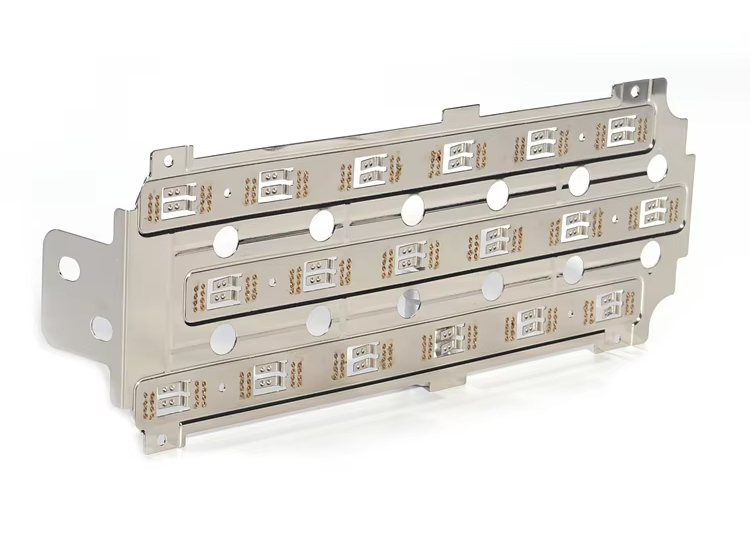
What are the benefits Custom Battery Bus bar Connectors?
- High-purity copper or aluminum (nickel plating optional) for low resistance (<0.5mΩ) and high current-carrying capacity (up to 500A)
- Optimized elastic support and vibration damping structure to absorb mechanical stress and improve heat dissipation efficiency Process Accuracy
- Ultrasonic welding technology ensures consistent joints (tolerance <±0.1mm)
- Environmental Resilience Salt Spray Test (240 hours) and Wide Temperature Range Verification (-45℃ to 150℃)
Kial elekti nin?
- Specialized Technology
- Deeply involved in the field of EV battery connection, providing integrated design of main busbar, connecting busbar and cooling unit.
- Supporting parallel/series hybrid layout, suitable for cylindrical, square and other cell sizes.
- Kvalita Asekuro
- Full-process testing: Strict control from raw material purity (copper ≥99.9%) to welding strength (tensile ≥50MPa).
- Conforms to international standards such as UL 4128 and supports 10,000 times plug life verification.
- Customized service
- Design Flexibility: Provide floating connector (tolerance compensation ±1.5mm) and blind plug compatible program.
- Fast response: 3D modeling + prototyping cycle time ≤ 7 days, support for small quantities (from 100 pieces) to millions of mass production.
- Cost optimization
- Increase material utilization by 30%, reduce processing loss by integrated stamping/bending process.
What is the application for battery Bus bar Connectors?
- Electric Vehicle Power Battery Pack
- Main circuit connection: connect the positive and negative terminals of the battery module to the high voltage box, support 800V platform design.
- Sampling line integration: built-in FPC connector for synchronized voltage/temperature signal transmission.
- Energy Storage System (ESS)
- Containerized battery cluster interconnection, supporting 1500VDC system voltage.
- Industria Ekipaĵo
- Forklift/AGV power battery, shock and vibration resistant (IEC 61373 standard).
How is the customization process battery Bus bar Connectors?
- Requirements analysis: Provide drawings or 3D models of battery pack stacks (STEP format recommended)
- Simulation verification: conduct thermal-force coupling analysis through ANSYS to optimize current-carrying and structural strength.
- Prototype testing: including:
- Temperature rise test (ΔT≤40K@rated current)
- Mechanical vibration (20Hz-2000Hz, 12 hours in each of the 3 axes).
- Mass Production Delivery: Provide RoHS/REACH compliance report and process quality control documentation.
For complete technical documentation or sample requests, please contact our engineering team.
 Esperanto
  English
  Arabic
  German
  Spanish
  French
  Russian
  Danish
  Japanese
  Italian
  Vietnamese
  Turkish
  Dutch
Dutch  Portuguese
  Thai
Thai  Swedish
  Korean
  Greek
Greek  Polish
  Estonian
  Hindi
Hindi  Indonesian
  Latvian