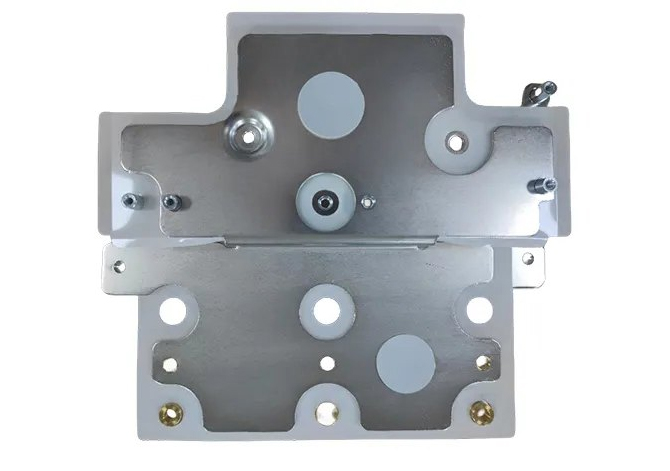
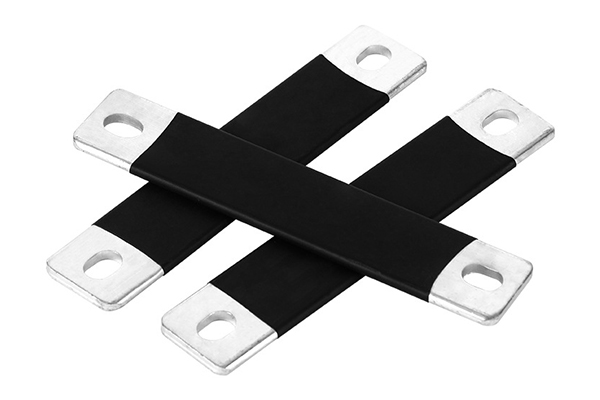
Our factory nickel-plated copper busbar is a conductive material that is uniformly covered with a layer of nickel metal on the surface of high-purity copper through the electroplating process and is widely used in high-demand scenarios such as power transmission, new energy equipment (e.g., batteries, photovoltaics), rail transportation, and communication base stations. Its core advantage lies in combining the high conductivity of copper with the corrosion resistance of nickel, which is suitable for harsh environments such as humidity, high temperature, and chemical corrosion.
| Item tipo | nikel tegita kupra busdrinkejo |
|---|---|
| Baza Materialo: | High purity electrolytic copper (purity ≥ 99.95%) nickel plating (nickel layer thickness 5-20μm) |
| Tegaĵo: | Nickel layer bonding ≥ 5N/mm², surface hardness HV200-300 |
| Taksita Tensio: | 250V-600V (depending on the model) |
| Kondukto: | ≥10V |
| Longo: | Agordigebla, kutime ĝis 6 metroj |
| Kondukto: | ≥ 98% IACS (Internacia Kura Kupra Normo) |
| Rezistemo: | ≤ 0,017241 ohm·mm²/m |
| Tirezo-forto: | 200-400 MPa (depende de specifa kupra grado) |
| Plilongigo: | 30-45% |
| Termika Kondukto: | 385 W/m·K |
| Funkcia Temperaturo Intervalo: | -65℃ to 260℃ (long-term use), short-term temperature resistance up to 300℃ |
| Nikela dikeco: | Tipe 1-10 mikronoj |
| Adhero: | Forta, unuforma ligo al la kupra substrato |
| Korodrezisto: | Bonega protekto kontraŭ korodo kaj oksigenado |
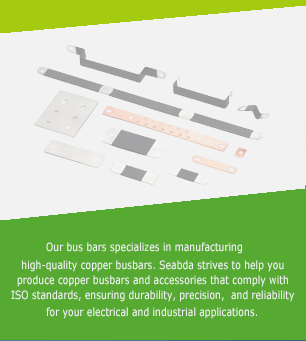
Via Ĉefa Nikel Tegita Kupra Busa Fabrikisto
Kiel ĉefranga fabrikisto, nia fabriko specialiĝas pri produktado de altkvalitaj nikel-tegitaj kupraj busbaroj por efika kaj fidinda potenco-distribuo. Niaj kupraj busbaroj estas kreitaj el altpura kupro kaj kovritaj per daŭrema tavolo de nikelo, dizajnita por plenumi la rigorajn postulojn de diversaj industriaj kaj komercaj aplikoj.
Production Process of nickel plate copper bus bar:
1. Copper wire preparation:
Adopt high-purity electrolytic copper through drawing and stranding processes to process it into the required diameter of copper wire, with tolerance control within ± 0.005mm.
2. Surface treatment:
Copper wire by ultrasonic cleaning and acid washing (such as with sulfamic acid) to remove surface oil and oxides.
3. Electroplating nickel layer:
Adopt the electroplating or chemical plating process, and control the current density (2-5A/dm²), temperature (50-60℃) and pH (3.5-5.5) to form a uniform and dense nickel layer.
4. Post-treatment:
Annealing to eliminate internal stress, ultrasonic cleaning to remove residues, drying and testing of coating thickness, bonding force, and other indicators.
5. Quality Inspection:
The use of high-precision instruments to detect the conductivity, plating uniformity, and corrosion resistance (such as salt spray test).
Kial Busbaroj Estas Nikelitaj?
1. Corrosion resistance:
Nickel in the humid, salt spray environment can form a passivation film, preventing oxidation of the copper substrate, prolonging the life of the busbar.
2. Reduce contact resistance:
The nickel layer has a smooth surface, which reduces the roughness of the contact surface and avoids the elevated resistance caused by oxidized copper and improves the efficiency of current transmission.
3. Abrasion resistance:
Nickel hardness (HV200-300) is much higher than copper (HV40-60), suitable for sliding contact scenarios (e.g. drawer cabinet connectors).
4. Solderability:
The nickel plating layer is stable at high temperature, superior to tin plating (easy to produce tin whiskers), and suitable for high-frequency welding processes.

Por kio estas nikelkovrita kupro?
With its high electrical conductivity, corrosion resistance, and abrasion resistance, nickel-plated copper is widely used in electronic communications, new energy, industrial manufacturing, and other fields: in electronic communications, it is used in 5G equipment, high-frequency circuit boards, and precision sensors to ensure the stable transmission of signals; in the new energy automotive and photovoltaic industries, it is used as a battery connector and high-voltage conductor to adapt to high temperatures, salt spray, and other harsh environments; and it is used for abrasion-resistant mechanical parts and chemical pipelines to resist friction and cost in the industry.
With the development of 5G, electric vehicles, and other industries, the application of nickel-plated copper will continue to expand in scenarios that require high conductivity and durability.
Ĉu nikelkovrita kupro estas pli bona ol kupro?
Kiel fabrikisto, ni rekonas, ke la taŭgeco de nikel-tegita kupro kontraŭ nuda kupro dependas de la specifaj aplikaj postuloj. Nikel-tegita kupro ofertas avantaĝojn laŭ plifortigita korodrezisto, oksigenadpreventado, kaj plibonigita fortikeco kompare kun nuda kupro. Ĉi tiuj avantaĝoj faras nikel-tegitan kupron precipe taŭga por aplikoj kie eksponiĝo al severaj medioj, korodaj substancoj aŭ longedaŭra uzo estas atendita. Tamen, nuda kupro povas esti preferita en aplikoj kie kostefikeco aŭ minimuma elektra rezisto estas prioritatitaj. Finfine, la elekto inter nikel-tegita kupro kaj nuda kupro dependas de faktoroj kiel ekzemple medikondiĉoj, spektakloatendoj, kaj buĝetlimoj.
| Karakterizaĵoj | Nickel-plated copper | Pure copper |
|---|---|---|
| Electrical Conductivity | Slightly lower (higher nickel resistivity) | Excellent (conductivity ≥100% IACS) |
| Koroda Rezisto | Excellent (resistant to oxidation, acids and alkalis) | Medium (easily oxidized to produce copper green) |
| Mekanika Forto | Alta | Meza |
| Environment | High humidity, high salt spray, high temperature | Dry, non-corrosive environment |
| Costs | Alta | Malalta |

 Esperanto
  English
  Arabic
  German
  Spanish
  French
  Russian
  Danish
  Japanese
  Italian
  Vietnamese
  Turkish
  Dutch
Dutch  Portuguese
  Thai
Thai  Swedish
  Korean
  Greek
Greek  Polish
  Estonian
  Hindi
Hindi  Indonesian
  Latvian