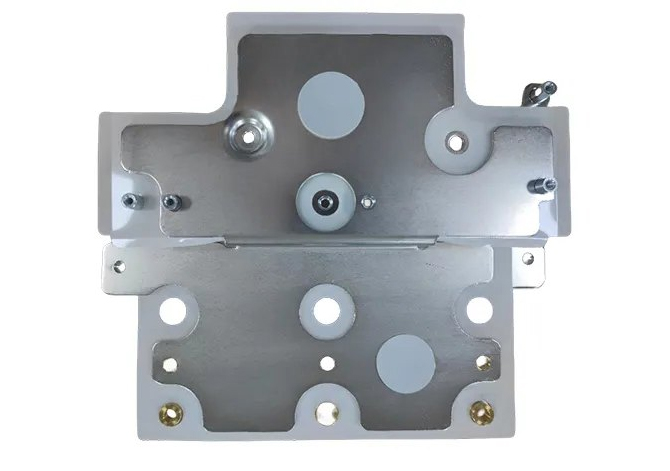
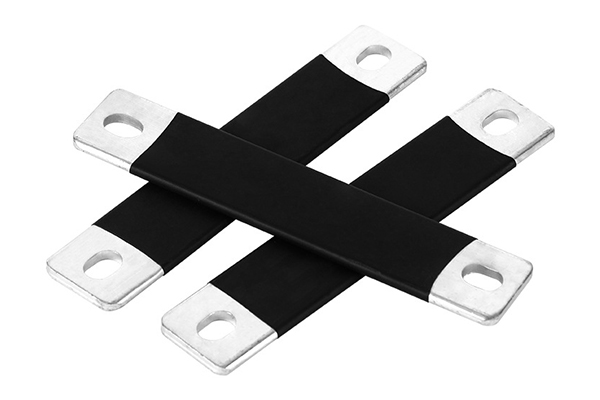
Barre omnibus en cuivre nickelé
√ Excellente conductivité électrique pour une distribution d'énergie efficace
√ Résistance mécanique et résistance à l'usure améliorées.
√ Empêche l’oxydation, maintenant des performances constantes.
√ Des performances fiables sur une large plage de températures.
√ Disponible en différentes tailles et configurations.
Our factory nickel-plated copper busbar is a conductive material that is uniformly covered with a layer of nickel metal on the surface of high-purity copper through the electroplating process and is widely used in high-demand scenarios such as power transmission, new energy equipment (e.g., batteries, photovoltaics), rail transportation, and communication base stations. Its core advantage lies in combining the high conductivity of copper with the corrosion resistance of nickel, which is suitable for harsh environments such as humidity, high temperature, and chemical corrosion.
| Type d'article | barre omnibus en cuivre nickelé |
|---|---|
| Matériau de base : | High purity electrolytic copper (purity ≥ 99.95%) nickel plating (nickel layer thickness 5-20μm) |
| Revêtement: | Nickel layer bonding ≥ 5N/mm², surface hardness HV200-300 |
| Tension nominale : | 250V-600V (depending on the model) |
| Conductivité: | ≥10V |
| Longueur: | Personnalisable, généralement jusqu'à 6 mètres |
| Conductivité: | ≥ 98% IACS (norme internationale sur le cuivre recuit) |
| Résistivité: | ≤ 0,017241 ohm·mm²/m |
| Résistance à la traction: | 200-400 MPa (selon la nuance de cuivre spécifique) |
| Élongation: | 30-45% |
| Conductivité thermique : | 385 W/m·K |
| Plage de température de fonctionnement : | -65℃ to 260℃ (long-term use), short-term temperature resistance up to 300℃ |
| Épaisseur du nickel : | Généralement 1 à 10 microns |
| Adhésion: | Adhésion forte et uniforme au substrat en cuivre |
| Résistance à la corrosion : | Excellente protection contre la corrosion et l'oxydation |
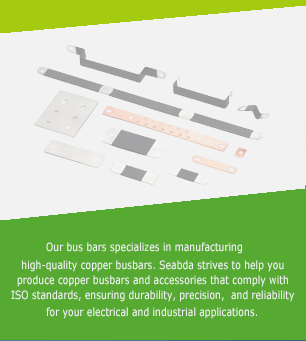
Votre premier fabricant de barres omnibus en cuivre nickelé
En tant que fabricant de premier plan, notre usine est spécialisée dans la production de barres omnibus en cuivre nickelé de qualité supérieure pour une distribution d'énergie efficace et fiable. Nos barres omnibus en cuivre sont fabriquées à partir de cuivre de haute pureté et recouvertes d'une couche de nickel durable, conçue pour répondre aux exigences rigoureuses de diverses applications industrielles et commerciales.
Production Process of nickel plate copper bus bar:
1. Copper wire preparation:
Adopt high-purity electrolytic copper through drawing and stranding processes to process it into the required diameter of copper wire, with tolerance control within ± 0.005mm.
2. Surface treatment:
Copper wire by ultrasonic cleaning and acid washing (such as with sulfamic acid) to remove surface oil and oxides.
3. Electroplating nickel layer:
Adopt the electroplating or chemical plating process, and control the current density (2-5A/dm²), temperature (50-60℃) and pH (3.5-5.5) to form a uniform and dense nickel layer.
4. Post-treatment:
Annealing to eliminate internal stress, ultrasonic cleaning to remove residues, drying and testing of coating thickness, bonding force, and other indicators.
5. Quality Inspection:
The use of high-precision instruments to detect the conductivity, plating uniformity, and corrosion resistance (such as salt spray test).
Pourquoi les barres omnibus sont-elles nickelées ?
1. Corrosion resistance:
Nickel in the humid, salt spray environment can form a passivation film, preventing oxidation of the copper substrate, prolonging the life of the busbar.
2. Reduce contact resistance:
The nickel layer has a smooth surface, which reduces the roughness of the contact surface and avoids the elevated resistance caused by oxidized copper and improves the efficiency of current transmission.
3. Abrasion resistance:
Nickel hardness (HV200-300) is much higher than copper (HV40-60), suitable for sliding contact scenarios (e.g. drawer cabinet connectors).
4. Solderability:
The nickel plating layer is stable at high temperature, superior to tin plating (easy to produce tin whiskers), and suitable for high-frequency welding processes.

A quoi sert le cuivre nickelé ?
With its high electrical conductivity, corrosion resistance, and abrasion resistance, nickel-plated copper is widely used in electronic communications, new energy, industrial manufacturing, and other fields: in electronic communications, it is used in 5G equipment, high-frequency circuit boards, and precision sensors to ensure the stable transmission of signals; in the new energy automotive and photovoltaic industries, it is used as a battery connector and high-voltage conductor to adapt to high temperatures, salt spray, and other harsh environments; and it is used for abrasion-resistant mechanical parts and chemical pipelines to resist friction and cost in the industry.
With the development of 5G, electric vehicles, and other industries, the application of nickel-plated copper will continue to expand in scenarios that require high conductivity and durability.
Le cuivre nickelé est-il meilleur que le cuivre ?
En tant que fabricant, nous reconnaissons que l'adéquation du cuivre nickelé par rapport au cuivre nu dépend des exigences spécifiques de l'application. Le cuivre nickelé offre des avantages en termes de résistance accrue à la corrosion, de prévention de l'oxydation et de durabilité améliorée par rapport au cuivre nu. Ces avantages rendent le cuivre nickelé particulièrement adapté aux applications où une exposition à des environnements difficiles, à des substances corrosives ou à une utilisation prolongée est attendue. Cependant, le cuivre nu peut être préféré dans les applications où la rentabilité ou une résistance électrique minimale est prioritaire. En fin de compte, le choix entre le cuivre nickelé et le cuivre nu dépend de facteurs tels que les conditions environnementales, les attentes en matière de performances et les contraintes budgétaires.
| Characteristics | Nickel-plated copper | Pure copper |
|---|---|---|
| Electrical Conductivity | Slightly lower (higher nickel resistivity) | Excellent (conductivity ≥100% IACS) |
| Résistance à la corrosion | Excellent (resistant to oxidation, acids and alkalis) | Medium (easily oxidized to produce copper green) |
| Résistance mécanique | Haut | Moyen |
| Environment | High humidity, high salt spray, high temperature | Dry, non-corrosive environment |
| Costs | Haut | Faible |

 French
  English
  Arabic
  German
  Spanish
  Russian
  Danish
  Japanese
  Italian
  Vietnamese
  Turkish
  Dutch
Dutch  Portuguese
  Thai
Thai  Swedish
  Korean
  Greek
Greek  Polish
  Estonian
  Esperanto
  Hindi
Hindi  Indonesian
  Latvian