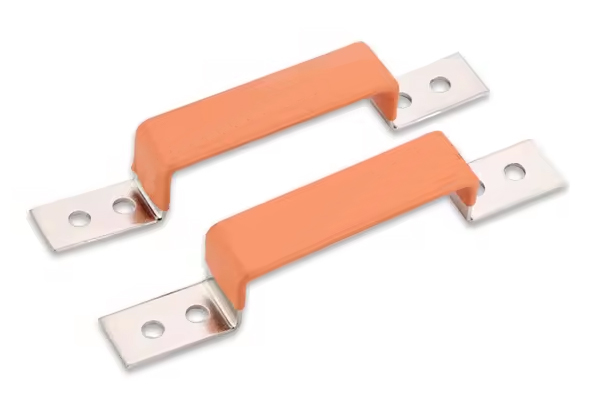
Barre omnibus en cuivre isolée flexible
√ Excellente conductivité électrique pour une transmission de puissance efficace.
√ La flexibilité permet une installation et un routage faciles dans les configurations.
√ La couche isolante assure la sécurité en évitant les chocs électriques.
√ Conception polyvalente adaptée à diverses applications basse tension.
√ Tailles et configurations personnalisables pour répondre aux exigences du projet.
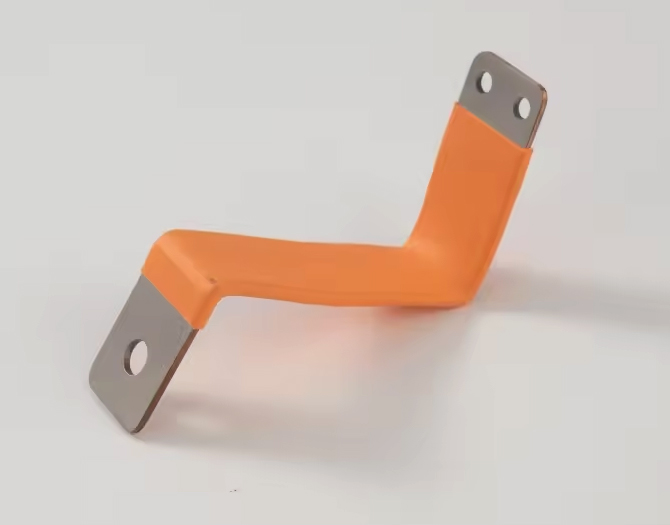
Our factory provides a range of flexible insulated copper busbars designed for diverse industrial and commercial electrical applications. Flexible insulated copper busbar is a kind of high current transmission and distribution innovative product made of multi-layer high purity copper tape or copper wire rows as conductor, covered with flexible insulating material. It combines the flexibility of cable with the current-carrying capacity of traditional busbar, which can be bent and laid in complex spaces and is suitable for high-current-density scenarios.
| Type d'article : | barre omnibus en cuivre étamé |
|---|---|
| Base matérielle: | T2 copper (purity ≥99.9%), optional tin-plated, nickel-plated or silver-plated treatment to improve corrosion resistance |
| Revêtement: | Étain (finition mate ou brillante) |
| Structure: | Multi-layer thin copper sheets laminated or stranded, width range 20-300mm, thickness 0.1-1.0mm, support customization. |
| Épaisseur: | 2 mm à 20 mm |
| Commonly used materials: | polyvinyl chloride (PVC), thermoplastic elastomer (TPE), silicone composite materials, etc. |
| Conductivité: | ≥ 98% IACS (norme internationale sur le cuivre recuit) |
| Load capacity: | 200A to 6300A (depending on the cross-section and number of layers). |
| Résistance à la traction: | 200-400 MPa (selon l'alliage et le tempérament spécifiques) |
| Élongation: | 30-40% (selon l'alliage et le tempérament spécifiques) |
| Dureté: | 40-80 HV (dureté Vickers) |
| Épaisseur du revêtement d'étain : | 3 à 15 microns (personnalisable) |
| Résistance à la corrosion : | Excellent, grâce au revêtement en étain |
| Température de fonctionnement : | 45℃ to 150℃, temperature rise as low as 35℃ (under rated current). |
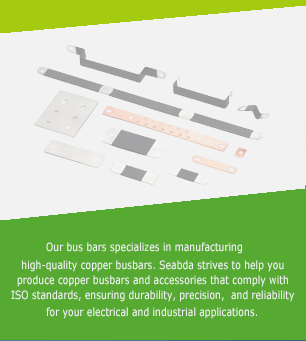
Fabricant leader de barres omnibus en cuivre isolées et flexibles
As an IATF 16949 certified manufacturer of flexible insulated copper busbars, we rely on fully automated production lines and UL standard laboratories to achieve product skin effect optimization and 1μm level insulation layer control. Specialized in new energy charging pile, IDC data center and other scenarios, the current carrying capacity is increased by 45% compared with traditional solutions, and supports -50℃~180℃ wide range temperature control. We provide customized solutions for cross-section/bending radius, deliver samples in 72 hours, and support a full life cycle technical response system to empower customers to build zero-fault power distribution networks.
How is production process for flexible insulated copper busbar?
1. Efficient power transmission
- Multilayer conductor structure reduces skin effect, and the current-carrying capacity is 30%-50% higher than that of cables with the same cross-section.
- No eddy current design, low line loss, power transmission efficiency of more than 99%.
2. Flexible installation
- Can be bent and laid in narrow spaces, reducing 90% of joints, and improving construction efficiency by 60%.
- Support outdoor, underground and other complex environments, without the need to reserve space for installation.
3. Safe and reliable
- Insulation breakdown voltage ≥20kV/mm, the outer sheath has no inductance, reducing the risk of electric shock.
- Resistant to corrosion, acid and alkali, suitable for chemical industry, metallurgy and other harsh environments.
4. Economy
- Copper consumption is reduced by 10%-20%, construction and maintenance costs are reduced by more than 50%.
- Lifetime maintenance-free, failure rate is only 1/5 of traditional busbar.
Quels sont les principaux avantages de l’utilisation de jeux de barres en cuivre isolés flexibles ?
1. Raw material treatment
- Pre-treatment of copper: Continuous casting and rolling of copper rods are straightened and deslagged, and then drawn into copper strips or stranded copper wire rows.
- Insulation material proportioning: mix PVC, TPE, etc. according to the demand to ensure flame retardant and weatherproof performance.
2. Conductor molding
- Laminated or stranded: multiple layers of copper tape are laminated or stranded to form a flexible conductor core.
3. Insulation Overlay
- Process: Extrusion or impregnation process, uniform coverage of insulation layer, thickness 1.5-2.1mm.
- Special treatment: some products add metal armor layer (such as aluminum alloy) to enhance pressure resistance.
4. Testing and Packaging
- Testing items: voltage resistance test (above 3.5kV), temperature rise test, salt spray test (above 240 hours).
- Packaging: moisture-proof and shock-proof treatment, support customized marking.
Dans quelles applications les jeux de barres en cuivre isolés flexibles sont-ils couramment utilisés ?
- New energy: Super charging station (e.g. Huawei 600kW liquid-cooled super charging), photovoltaic energy storage system, to solve the high-power power supply needs.
- IDC server room: High load capacity to support server clusters, good heat dissipation to avoid local temperature rise, space saving.
- Railway transportation: Adapt to tunnels, bridges and other complex terrain, anti-vibration performance.
- Military and Aerospace: Resistant to extreme temperature and radiation, in line with the standards of autonomous control and high reliability.
- Industry and construction: High-rise building power distribution, metallurgical and chemical equipment power supply, replacing traditional cables and rigid bus ducts.
Quels matériaux sont utilisés pour l'isolation ?
- PVC (polyvinyl chloride): Low cost, good flame retardant, but contains halogens and releases toxic gases when burned.
- TPE (thermoplastic elastomer): Environmentally friendly materials, low smoke and halogen-free, wide range of temperature resistance (-40 ℃ to 105 ℃).
- Silicone composite materials: High temperature resistance (-60°C to 200°C), excellent flexibility, used in high demand scenarios such as military industry.
- Résine époxy :High mechanical strength, suitable for high-pressure environments, but at a higher cost.

 French
  English
  Arabic
  German
  Spanish
  Russian
  Danish
  Japanese
  Italian
  Vietnamese
  Turkish
  Dutch
Dutch  Portuguese
  Thai
Thai  Swedish
  Korean
  Greek
Greek  Polish
  Estonian
  Esperanto
  Hindi
Hindi  Indonesian
  Latvian