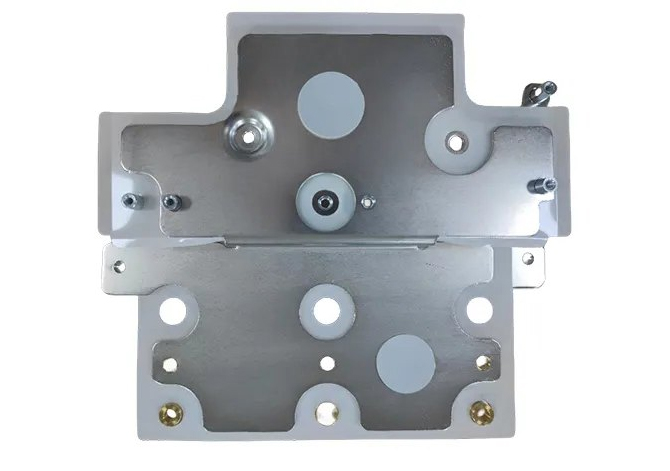
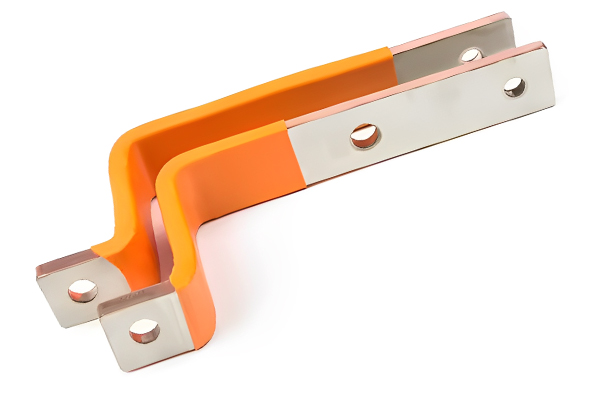
Barre omnibus en cuivre personnalisée
√ Les noyaux en cuivre assurent une distribution d'énergie efficace.
√ Améliore les performances électriques.
√ Résiste à l’usure et aux dommages mécaniques.
√ Idéal pour la distribution électrique, les appareillages de commutation et plus encore.
√ Répond aux normes de qualité et de fiabilité de l’industrie.
En tant que fabricant leader, nous produisons des barres omnibus en cuivre massif de haute qualité conçues pour une excellente conductivité électrique et une excellente durabilité. Idéales pour les applications de distribution d'énergie et de mise à la terre, nos barres omnibus offrent des performances fiables dans les environnements commerciaux et industriels. Avec des propriétés thermiques et électriques supérieures, une résistance à la corrosion et une forte résistance mécanique, nos barres omnibus en cuivre massif assurent un transfert de puissance efficace et une fiabilité à long terme. Personnalisables pour répondre à des exigences spécifiques, nos produits sont fabriqués selon les normes industrielles les plus strictes. Choisissez nos barres omnibus en cuivre massif pour des performances et une efficacité supérieures dans vos systèmes électriques.
| Type de produit | cuivre burbar |
|---|---|
| Teneur en cuivre : | C11000 (cuivre pur 99,9%) ou autres nuances sur demande |
| Épaisseur: | 1 mm à 10 mm |
| Largeur: | 10 mm à 200 mm |
| Longueur: | Personnalisable, généralement jusqu'à 6 mètres |
| Conductivité: | ≥ 98% IACS (norme internationale sur le cuivre recuit) |
| Résistivité: | ≤ 0,017241 ohm·mm²/m |
| Résistance à la traction: | 200-400 MPa (selon la nuance de cuivre spécifique) |
| Élongation: | 30-45% (indicatif de flexibilité et de ductilité) |
| Conductivité thermique : | 385 W/m·K |
| Coefficient de dilatation thermique : | 16,5 x 10^-6 /°C |
| Finition standard : | Lisse, brillant et poli |
| Finitions optionnelles : | Revêtements étamés, argentés ou personnalisés pour une meilleure résistance à la corrosion |
| Résistance à la corrosion : | Haute résistance à la corrosion atmosphérique et chimique |
| Plage de température de fonctionnement : | -65°C à +150°C |

Barre omnibus principale Cuivre Fabricant
As a manufacturer of busbar copper, our production process, size design and selection criteria are directly related to the safety and efficiency of the power distribution system. From the production process optimization, size selection science, performance verification system and other dimensions to provide a systematic reference for engineering design.
First, the busbar copper row production process
Modern busbar copper production has formed a standardized process, covering raw material handling, processing molding, surface treatment of the three major links (see Figure 1). Take Hubei Ruineng Electric as an example, its core process includes:
- Raw material screening: T2 electrolytic copper with purity ≥99.95% is used, and the copper content and impurity ratio are detected by spectral analyzer to ensure that the conductivity is ≥58MS/m (IACS standard);
- Precision processing:
- Cutting process uses laser cutting machine to control the tolerance ≤±0.1mm, avoiding the burr problem caused by traditional punching and shearing;
- The bending process uses a three-point hydraulic bending machine with a bending radius of 2.5-5 times the width to ensure that there are no cracks at the bending corners (GB/T 5585.1-2018);
- Surface treatment: the thickness of the tin-plated layer is controlled at 8-12μm, which not only improves the oxidation resistance (salt spray test ≥ 720h), but also limits the increase in contact resistance to less than 7%.
Comparison of copper processing equipment
| Equipment Type | Accuracy Level | Application | Efficiency Enhancement |
|---|---|---|---|
| Conventional Punch Press | ±0.5mm | Low Precision Mass Production | Benchmark |
| CNC Bending Machine | ±0.1mm | Complex shaped parts processing | 300% |
| Automatic Tinning Line | Uniform Plating | Products with High Corrosion Protection Requirements | 200% |
Second, dimensional design of bubar copper:
- Load capacity calculation
According to IEC 61439 standard, the formula of current-carrying capacity is: 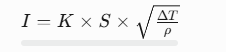
- ( K ): heat dissipation coefficient (1.1 for vertical, 1.0 for flat)
- ( S ): cross-sectional area (mm²)
- ( ΔT ): allowable temperature rise (usually taken as 55K)
- ( ρ ): resistivity (0.01774Ω-mm²/m)
Copper row current-carrying capacity (ambient temperature 35℃)
| Specification (mm | Flat discharge current
-carrying capacity (A) |
Vertical discharge current
-carrying capacity (A) |
Cross-sectional area (mm²) |
|---|---|---|---|
| 30×4 | 475 | 520 | 120 |
| 60×6 | 1069 | 1125 | 360 |
| 100×10 | 2121 | 2310 | 1000 |
third, Digital Transformation of Performance Verification System
- Mechanical performance testing:
- Tensile strength ≥295MPa (China Steel National Inspection cases show a pass rate of 99.8%)
- Brinell hardness HB≥80 to ensure the stability of installation.
- Electrical test:
- Insulation resistance ≥ 20MΩ (2500V withstand voltage test)
- Temperature rise test: 2000A copper row under full load temperature rise ≤ 55K
- Environmental simulation:
- Humidity and heat cycle test (85 ℃ / 85% RH) 1000 hours after the insulation performance degradation < 5%
Fourth, industry application scenarios Customized development according to the special needs of application scenarios:
- Nouveau domaine énergétique :
- Battery pack connecting row adopts 0.2mm ultra-thin insulation layer, and the voltage resistance level is increased to 3000V.
- Seismic design through GB/T 31467.3 standard (random vibration 27.8m/s²)
- High-voltage switchgear:
- The 10kV system prioritizes the use of vertically placed 80×8mm specifications, and the current-carrying capacity has been increased by 18%
What is the technology for our busbar copper?
- Application of recycled copper: new refining technology makes the purity of recycled copper up to 99.9% and reduces carbon emission by 40%.
- Intelligent monitoring system: implanted RFID chip real-time monitoring of temperature, deformation, early warning accuracy>95%.
- Modular design: standard connectors library reduces installation time by 15% (Siemens case).

 French
  English
  Arabic
  German
  Spanish
  Russian
  Danish
  Japanese
  Italian
  Vietnamese
  Turkish
  Dutch
Dutch  Portuguese
  Thai
Thai  Swedish
  Korean
  Greek
Greek  Polish
  Estonian
  Esperanto
  Hindi
Hindi  Indonesian
  Latvian