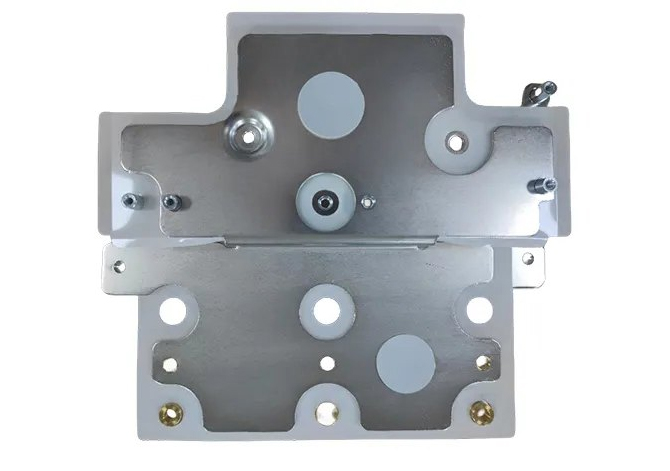
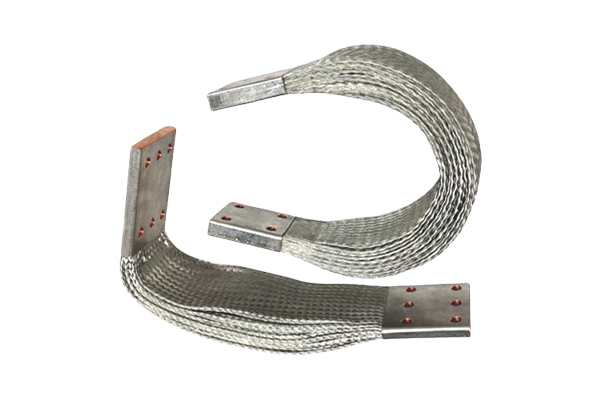
Barre omnibus en cuivre tressé flexible
√ Conception flexible pour un pliage et un façonnage faciles.
√ Haute résistance mécanique pour une durabilité et une fiabilité optimales.
√ Résistant à la corrosion pour des performances à long terme.
√ Conductivité électrique améliorée grâce aux conducteurs en cuivre tressé.
√ Longueurs, diamètres et configurations de tressage personnalisables.
As a manufacturer of flexible braided copper busbars, we pride ourselves on delivering top-quality products known for their flexibility, durability, and conductivity. Our copper busbars, made of high purity copper wire (such as C11000 or T2 copper) by precision braiding process, with excellent conductivity, corrosion resistance and mechanical strength. Its core feature lies in the flexible structural design, which allows bending and installation in complex spaces, and at the same time meets the demand for high-current transmission, which is widely used in electric power systems, new energy equipment and industrial fields.
| Type d'article : | Barre omnibus tressée flexible en cuivre |
|---|---|
| Base matérielle: | Cuivre 99,9% |
| Application: | Énergie, sous-station électrique, générateur, transformateur, appareillage de commutation |
| Gamme de fils : | 2,5-1000 mm2 au-dessus |
| Longueur: | Personnalisable, généralement jusqu'à 6 mètres |
| Genre: | Dérivation de puissance |
| Taper: | Barre omnibus de connexion tressée en cuivre étamé |
| Fabricant/fabricant d'équipement d'origine (FEO)/ODM : | Prise en charge de la personnalisation |
| tension: | Haute et basse pression |
| Approprié: | Four industriel, fusion électrolytique, équipement de soudage |
| Recouvert: | Cuivre rouge ou cuivre étamé |
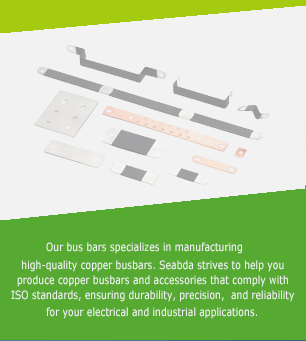
Fabricant leader de barres omnibus en cuivre tressées flexibles
Our flexible braided copper busway adopts multi-directional spiral braiding technology, which can be freely bent and twisted within the range of ±180°, breaks through the space limitation of the traditional rigid conductor, and supports the completion of wiring installation within the ultra-narrow gap of 20mm. Through the three-dimensional braided structure design, the product can effectively absorb more than 90% of the mechanical vibration in the operation of the equipment, and maintain stable conductivity in the dynamic stress environment, the service life of the conventional products to enhance three times.
Different from the standard product suppliers, we have built a customized development system from design to production: we support the customization of cross-sectional area (1.5-6000mm²), weaving density (24 spindles to 128 spindles), protection level (IP44 to IP68) and other dimensions, and we can integrate special treatment processes such as tin plating/nickel plating/fluorocarbon coating. Currently, it has been successfully applied in new energy vehicle battery module (realizing 1200A/mm² current-carrying density), flexible joints of industrial robots (resisting 100,000 times of bending) and dynamic tracking system of photovoltaic power station (resisting -40℃ extreme cold environment), providing precise conductive solutions for 200+ customers.
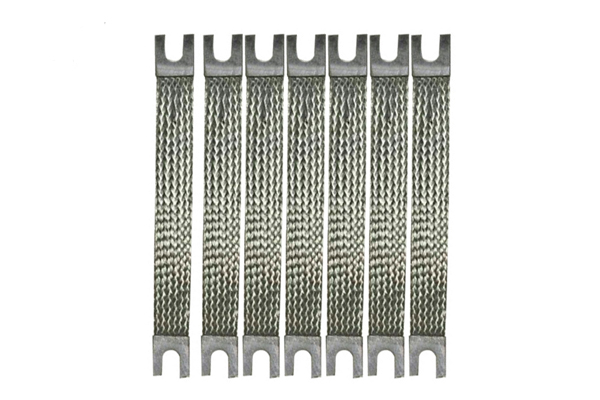
Production Process with Flexible Braided Copper Busbars
1. Raw material treatment
- Electrolytic copper is melted into copper rods through the upper lead furnace, and then made into copper wires through continuous casting and rolling process.
2. Braiding and molding
- Copper wire is braided into flat or cylindrical structure by multi-spindle braiding machine to ensure flexibility and even flow.
3. Welding and crimping
- Diffusion welding or cold crimping is used to connect the copper tube terminals at both ends to ensure the tightness of the joints.
4. Surface treatment
- Plating process: optional tin, nickel or silver plating to enhance corrosion resistance (tin plating is low cost, nickel plating is salt spray resistant up to 240 hours).
- Mechanical polishing: alternative to pickling to avoid corrosion residue, to ensure a matte functional surface.
5. Insulation and Inspection
- Wrap PVC heat shrink tubing or impregnated with insulating paint for voltage resistance test (e.g. 3500VDC leakage ≤ 0.025mA).
Surface Treatment For Flexible Braided Copper Busbars
1. Plating Options
- Tin plating: low cost, excellent conductivity, but easy to oxidize and change color, need regular maintenance.
- Nickel plating: strong corrosion resistance, suitable for high salt spray environment, but conductivity is slightly inferior
- Antioxidant coating: environmentally friendly surface treatment, such as silicone film, both anti-corrosion and conductivity.
2. Processing technology
- Thermal plating: metallurgical bonding, strong bonding force, suitable for simple structures.
- Electroplating: Suitable for complex shapes, but need to avoid crevice corrosion caused by pickling.
Product Advantages For Flexible Braided Copper Busbars
- High conductivity: copper purity ≥99.95%, low resistivity, reduce transmission loss.
- Flexible and durable: braided structure allows 15° arc bending over 10,000 times without breakage.
- Corrosion resistance: tin/nickel plating and protective layer to adapt to humidity, high temperature and other harsh environments.
- Convenient installation: integrated design reduces the number of connection points, reducing construction difficulties and costs.
- Economical and efficient: high material utilization, low maintenance costs, life expectancy of more than 20 years.
Application For Flexible Braided Copper Busbars
1. Electric power system: substation grounding wire, high and low voltage switchgear connection.
2. new energy: electric vehicle battery pack, charging pile, photovoltaic inverter
3. industrial equipment: electric furnace, transformer, vacuum electrical flexible connection
4. rail transportation: high-speed rail, subway power supply system conductive components
5. Data center: UPS power supply system, low-voltage distribution busbar
6. Marine and aviation: vibration-resistant, salt spray-resistant electrical connections.

 French
  English
  Arabic
  German
  Spanish
  Russian
  Danish
  Japanese
  Italian
  Vietnamese
  Turkish
  Dutch
Dutch  Portuguese
  Thai
Thai  Swedish
  Korean
  Greek
Greek  Polish
  Estonian
  Esperanto
  Hindi
Hindi  Indonesian
  Latvian