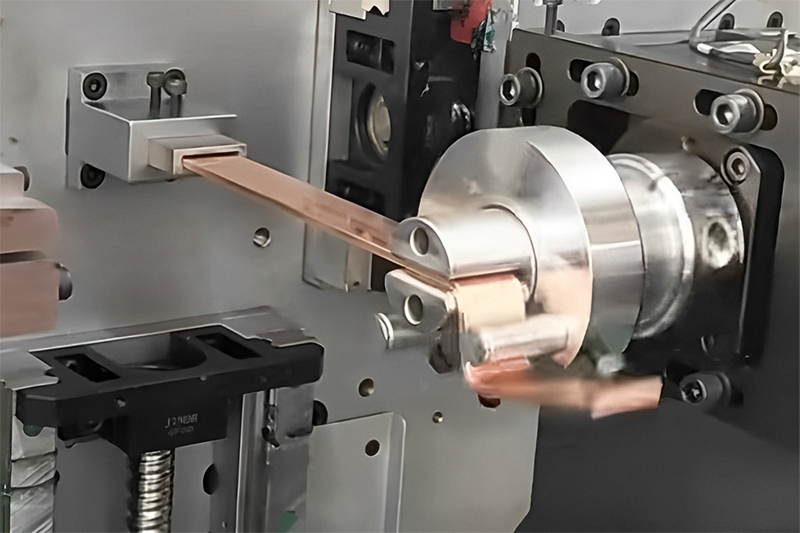
Busbar tembaga bending is a key process in the manufacture of power equipment; its accuracy directly affects the safety of equipment and conductivity. This article combines industry standards and experimental data to systematically analyze the copper bending pre-treatment, mechanical calculations, tool selection, and other 10 technical points and reveal the direction of process optimization through parameter comparison.
1. Pretreatment and material
- Dimensional error control
Copper busbar bending before the need to accurately measure the length, width, and thickness, the permissible error ≤ 0.5mm (power equipment scenes), overshooting may lead to poor contact or local overheating. - surface treatment process
Ultrasonic cleaning with a neutral cleaning agent can remove oil, and sandpaper (400 mesh or more) can polish the oxide layer and reduce the risk of bending cracks. Brass (yield strength 280 MPa) is easier to bend than pure copper busbar; you need to adjust the pressure according to the material.
2. Bending force and tool selection
- Pressure parameter calculation
A thickness of 3mm copper rows needs 4.5-7.5 tons of pressure; thickness and pressure are positively correlated (formula: pressure = thickness × 1.5-2.5 MPa). - Mold selection criteria
| Copper busbar thickness | Mold hardness (HRC) | Recommended materials |
|---|---|---|
| ≤5mm | 50-55 | Alloy tool steel |
| >5mm | 55-60 | High speed steel |
- Advantages of CNC equipment
CNC bending machine programming error ≤ 0.1 °; the efficiency is 3 times higher than manual; the scrap rate is reduced by 40% (the case of an auto parts manufacturer).
3. Process parameters and quality control
- Inner and outer fillet ratio
The radius of inner fillet should be 1.5-2 times of the thickness of the busbar(Example: R15-R20 is recommended for 10mm thick copper busbar) to avoid cracking of outer fillet. - Unfolding length calculation
Formula: Unfolding length = sum of linear dimensions + n×π×(R inside + R outside)/2 (n is the number of bending), 45°beveled angle should be corrected by superimposing the collinear theorem. - Current Density Selection
| Current Range | Allowable Current Density (A/mm²) |
|---|---|
| ≤200A | 3-4 |
| 200-500A | 2-3 |
| >1000A | 0.8-1.2 |
4. Defect Prevention, Control and Detection
- Surface defect determination (
Crack length >1mm or broken plating needs to be reworked; microscope inspection can identify micron-level damage. - Safety protection specification
Operators need to wear cut-resistant gloves (EN388 standard) and goggles (ANSI Z87.1 certification), and hydraulic equipment needs to be equipped with an emergency stop device.
Kesimpulan
Copper busbar bending needs to integrate material science, mechanical calculations, and precision manufacturing technology. Through the optimization of pre-processing, the application of CNC equipment, and data-based parameter control, it can significantly improve the finished product qualification rate.
Product Categories
〉 Batang bus tembaga berlapis timah
〉 Batang bus tembaga berlapis nikel
Related Post
Why can’t a copper busbar and an aluminum busbar be directly connected?
[email protected]2025-12-08T02:54:03+00:00Desember 8th, 2025|0 Comments
Introduction Copper busbars and aluminum busbars are the two most commonly used conductive materials in the field of power systems and industrial distribution. Due to differences in cost, resource availability, and technical requirements, they often
How to Prepare for a Big Win at Tez888 Casino
Developer Ismail2025-10-04T21:44:04+00:00Oktober 4th, 2025|0 Comments
When aiming for a significant payout at Tez888 casino, one crucial step often overlooked is thorough receipt checking and verification. Properly managing your transaction records not only ensures transparency but also plays a vital role
Tips and Tricks for Successful Betting on Bettilt
Developer Ismail2025-08-17T05:29:18+00:00Agustus 17th, 2025|0 Comments
When engaging in online betting, particularly on platforms like bettilt, it's crucial to incorporate strategies such as receipt checking, tax optimization, and thorough verification to maximize your success. These elements ensure that your betting activities

How Do You Calculate the Size of a Copper Busbar?
[email protected]2025-06-06T06:54:57+00:00Juni 6th, 2025|0 Comments
1. Introduction to Busbar Sizing Accurate copper busbar sizing is vital for secure, dependable, and effective electric circulation. Busbars disperse high currents in switchgear and panelboards. Inappropriate sizing reasons extreme warmth, power loss, voltage
10 Essential Tips for Working with Copper Busbars
[email protected]2025-06-03T06:35:28+00:00Juni 3rd, 2025|0 Comments
In modern power systems, copper busbars have actually become a core element in power transmission and distribution because of their superb electric conductivity, rust resistance and mechanical strength. As a specialist manufacturer of copper
A Guide to Maintaining Copper Busbars Effectively
[email protected]2025-05-28T06:09:36+00:00Mei 28th, 2025|0 Comments
As a core component of power transmission systems, copper busbars are an important choice for industry due to their high electrical conductivity, corrosion resistance and mechanical strength. However, the durability of its performance is
HUBUNGI KAMI
Kami Mengirimkan Busbar Kustomisasi Apa Pun
Posting Terkait
Nam lacinia arcu tortor, nec luctus nibh dignissim eu nulla sit amet maximus.

Nam lacinia arcu tortor, nec luctus nibh dignissim eu nulla sit amet maximus.
Nam lacinia arcu tortor, nec luctus nibh dignissim eu nulla sit amet maximus.
Nam lacinia arcu tortor, nec luctus nibh dignissim eu nulla sit amet maximus.

 Indonesian
  English
  Arabic
  German
  Spanish
  French
  Russian
  Danish
  Japanese
  Italian
  Vietnamese
  Turkish
  Dutch
Dutch  Portuguese
  Thai
Thai  Swedish
  Korean
  Greek
Greek  Polish
  Estonian
  Esperanto
  Hindi
Hindi  Latvian