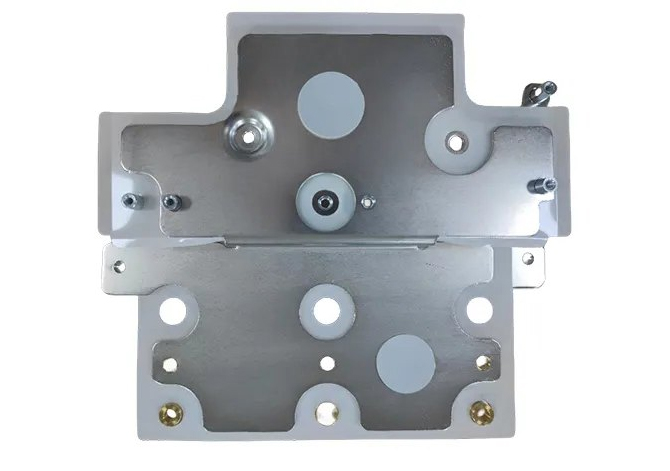
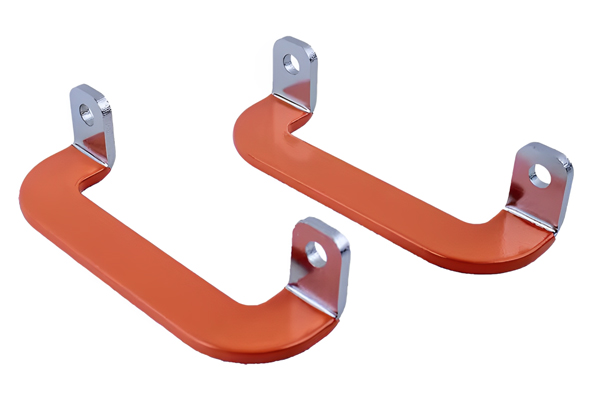
Our flat insulated solid copper busbar is an electrically conductive material designed for high current transmission. The core is made of high-purity copper (e.g. T1/T2 oxygen-free copper) covered with an insulating layer (e.g. PTFE, polyimide film or fiberglass composite), which provides a compact structure, high current-carrying capacity, and excellent heat dissipation performance. Its design reduces skin effect and eddy current loss, and is suitable for complex electromagnetic environments and high-temperature scenarios.
| 製品タイプ | ソリッド銅バスバー |
|---|---|
| 銅グレード: | 銅(99.9% Cu) |
| Current-carrying capacity: | 250A-5500A (e.g., 80×10mm copper tube 5500A, 40×4mm flat copper row 506A). |
| Insulation thickness: | 0.2-0.9mm (polyimide or glass fiber coating). |
| 幅: | 20-200mm, Thickness: 3-16mm (e.g., 40×4mm, 80×10mm, etc.). |
| 長さ: | 最大3000mm(カスタマイズ可能) |
| Tensile strength: | ≥80HRA in hard state, 180° bendable in soft state. |
| Insulation material temperature resistance: | 200~400 MPa(銅のグレードによって異なります) |
| 降伏強度: | -25℃ to 180℃ (PTFE). |
| 伸長: | 30% から 45% |
| 銅表面: | 滑らかで導電性の高い仕上げ |
| 絶縁: | 滑らかで均一なコーティング |
| 接触抵抗: | < 0.2mΩ |
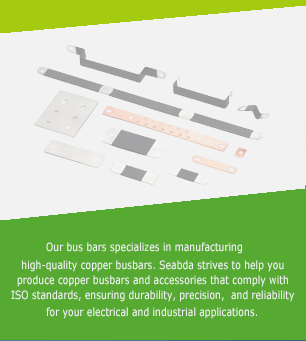
信頼できる純銅バスバーメーカー
当社は、優れた導電性と耐久性を備えた高品質の純銅バスバーの製造を専門としています。最先端の設備により、お客様の特定のニーズに合わせてさまざまなサイズと構成のバスバーを製造できます。正確な寸法、絶縁タイプ、仕上げなど、包括的なカスタマイズ オプションを提供し、バスバーがお客様のアプリケーションにシームレスに適合するようにします。配電盤、スイッチギア、再生可能エネルギー システムのいずれの場合でも、最適なパフォーマンスと安全性を実現する信頼性の高いソリューションを提供します。カスタム純銅バスバーの要件についてご相談いただくには、今すぐお問い合わせください。
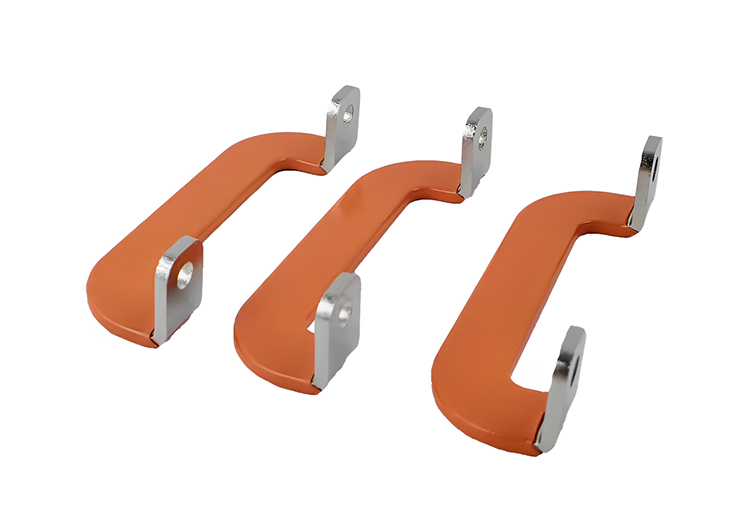
Solid copper busbar Surface Production process:
1. Raw material processing: High-purity copper rods from the continuous casting and rolling process are selected, and the oxidized layer is removed by straightening and pickling.
2. Molding processing: made into a flat cross section by drawing and calendering processes to ensure the dimensional accuracy (tolerance ±0.12mm).
3. Insulation processing:
- Extrusion/Coating: Polyimide film or glass fiber is extruded at high temperature or vacuum coated to cover the copper surface.
- Curing: Heat is applied to the insulating material to form a dense protective layer.
4. Quality testing: including conductor resistance test, insulation withstand voltage test (e.g., 20 20kV/mm), aging test.
5. Finished product packaging: moisture-proof and shock-proof packaging, part of the need for shielding treatment (such as tin-plated anti-oxidation).
Solid copper busbar Surface treatment process:
1. Plating technology:
- Tin/silver plating: Enhance corrosion resistance (tin plating thickness 10-20μm) and conductivity (silver plating to reduce contact resistance).
- Nickel plating: enhances wear resistance and oxidation resistance, suitable for high-humidity environments.
2. Passivation treatment: chemical passivation to form an oxide film to prevent copper surface oxidation.
3. Mechanical treatment:
- Polishing/Brushing: Reduce surface roughness (Ra≤0.8μm), reduce current loss.
- Sandblasting: increases the friction coefficient, suitable for anti-slip demand scenarios.
Solid copper busbar Advantages:
1. High efficiency and energy saving:
- Compared with the cable to save copper 10-35%, power loss is reduced by more than 15%.
- Low skin effect (AC resistance / DC resistance coefficient ≤ 1.1) reduces heat.
2. High reliability:
- Insulation layer is chemical resistant (e.g. PTFE), life expectancy of over 30 years.
- Support ultrasonic welding, high connection strength, and no heat-affected zone.
3. Adaptable:
- Compact design saves space, customizable bending radius (≥10 times thickness).
- Suitable for high-temperature (110℃), high-humidity, and electromagnetic interference environments.
Solid copper busbar Application:
1. Power system: high voltage switchgear (40.5kV), substation busbar, smart grid transmission.
2. New energy:
- PV/wind power inverter, new energy vehicle battery pack connection.
- Charging pile high current transmission (support more than 5000A).
3. Industrial equipment: metallurgical furnace, chemical explosion-proof power distribution system.
4. High-end manufacturing:
- Data center server power supply (such as AI server cluster).
- Aerospace and rail transportation (lightweight, high reliability requirements).
Aerospace and rail transportation (lightweight, high reliability requirements):

 Japanese
  English
  Arabic
  German
  Spanish
  French
  Russian
  Danish
  Italian
  Vietnamese
  Turkish
  Dutch
Dutch  Portuguese
  Thai
Thai  Swedish
  Korean
  Greek
Greek  Polish
  Estonian
  Esperanto
  Hindi
Hindi  Indonesian
  Latvian