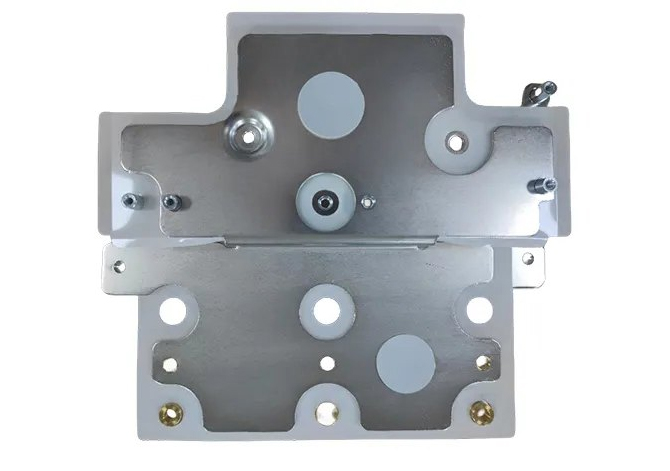
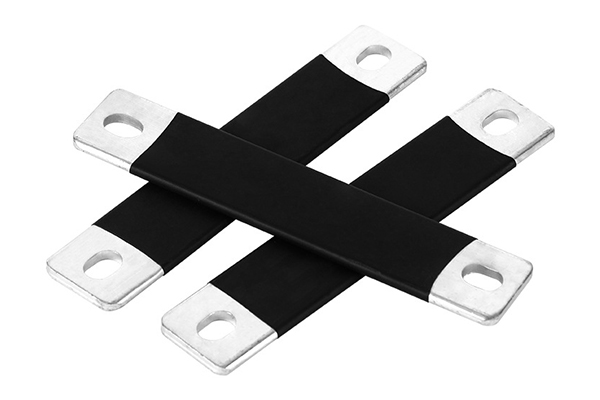
Our factory nickel-plated copper busbar is a conductive material that is uniformly covered with a layer of nickel metal on the surface of high-purity copper through the electroplating process and is widely used in high-demand scenarios such as power transmission, new energy equipment (e.g., batteries, photovoltaics), rail transportation, and communication base stations. Its core advantage lies in combining the high conductivity of copper with the corrosion resistance of nickel, which is suitable for harsh environments such as humidity, high temperature, and chemical corrosion.
| アイテムタイプ | ニッケルメッキ銅バスバー |
|---|---|
| ベース素材: | High purity electrolytic copper (purity ≥ 99.95%) nickel plating (nickel layer thickness 5-20μm) |
| コーティング: | Nickel layer bonding ≥ 5N/mm², surface hardness HV200-300 |
| 定格電圧: | 250V-600V (depending on the model) |
| 導電率: | ≥10V |
| 長さ: | カスタマイズ可能、通常は最大6メートル |
| 導電率: | ≥ 98% IACS (国際軟銅規格) |
| 抵抗率: | ≤ 0.017241オーム·mm²/m |
| 抗張力: | 200~400 MPa(銅のグレードによって異なります) |
| 伸長: | 30-45% |
| 熱伝導率: | 385W/m·K |
| 動作温度範囲: | -65℃ to 260℃ (long-term use), short-term temperature resistance up to 300℃ |
| ニッケルの厚さ: | 通常1~10ミクロン |
| 接着力: | 銅基板への強力で均一な結合 |
| 耐腐食性: | 腐食や酸化に対する優れた保護 |
ニッケルメッキ銅バスバーのトップメーカー
一流メーカーとして、当社の工場は、効率的で信頼性の高い電力分配を実現する最高品質のニッケルメッキ銅バスバーの製造を専門としています。当社の銅バスバーは、高純度銅から作られ、耐久性のあるニッケル層でコーティングされており、さまざまな産業および商業用途の厳しい要求を満たすように設計されています。
Production Process of nickel plate copper bus bar:
1. Copper wire preparation:
Adopt high-purity electrolytic copper through drawing and stranding processes to process it into the required diameter of copper wire, with tolerance control within ± 0.005mm.
2. Surface treatment:
Copper wire by ultrasonic cleaning and acid washing (such as with sulfamic acid) to remove surface oil and oxides.
3. Electroplating nickel layer:
Adopt the electroplating or chemical plating process, and control the current density (2-5A/dm²), temperature (50-60℃) and pH (3.5-5.5) to form a uniform and dense nickel layer.
4. Post-treatment:
Annealing to eliminate internal stress, ultrasonic cleaning to remove residues, drying and testing of coating thickness, bonding force, and other indicators.
5. Quality Inspection:
The use of high-precision instruments to detect the conductivity, plating uniformity, and corrosion resistance (such as salt spray test).
バスバーはなぜニッケルメッキされているのですか?
1. Corrosion resistance:
Nickel in the humid, salt spray environment can form a passivation film, preventing oxidation of the copper substrate, prolonging the life of the busbar.
2. Reduce contact resistance:
The nickel layer has a smooth surface, which reduces the roughness of the contact surface and avoids the elevated resistance caused by oxidized copper and improves the efficiency of current transmission.
3. Abrasion resistance:
Nickel hardness (HV200-300) is much higher than copper (HV40-60), suitable for sliding contact scenarios (e.g. drawer cabinet connectors).
4. Solderability:
The nickel plating layer is stable at high temperature, superior to tin plating (easy to produce tin whiskers), and suitable for high-frequency welding processes.

ニッケルメッキ銅は何に使用されますか?
With its high electrical conductivity, corrosion resistance, and abrasion resistance, nickel-plated copper is widely used in electronic communications, new energy, industrial manufacturing, and other fields: in electronic communications, it is used in 5G equipment, high-frequency circuit boards, and precision sensors to ensure the stable transmission of signals; in the new energy automotive and photovoltaic industries, it is used as a battery connector and high-voltage conductor to adapt to high temperatures, salt spray, and other harsh environments; and it is used for abrasion-resistant mechanical parts and chemical pipelines to resist friction and cost in the industry.
With the development of 5G, electric vehicles, and other industries, the application of nickel-plated copper will continue to expand in scenarios that require high conductivity and durability.
ニッケルメッキ銅は銅よりも優れていますか?
メーカーとして、ニッケルメッキ銅と裸銅のどちらが適しているかは、特定の用途要件によって決まることを認識しています。ニッケルメッキ銅は、裸銅に比べて耐腐食性、酸化防止性、耐久性が向上しているという利点があります。これらの利点により、ニッケルメッキ銅は、過酷な環境、腐食性物質にさらされる、または長期間の使用が予想される用途に特に適しています。ただし、費用対効果や最小限の電気抵抗が優先される用途では、裸銅が好まれる場合があります。最終的に、ニッケルメッキ銅と裸銅のどちらを選択するかは、環境条件、パフォーマンスの期待値、予算の制約などの要因によって決まります。
| Characteristics | Nickel-plated copper | Pure copper |
|---|---|---|
| Electrical Conductivity | Slightly lower (higher nickel resistivity) | Excellent (conductivity ≥100% IACS) |
| 耐腐食性 | Excellent (resistant to oxidation, acids and alkalis) | Medium (easily oxidized to produce copper green) |
| Mechanical Strength | 高い | 中くらい |
| Environment | High humidity, high salt spray, high temperature | Dry, non-corrosive environment |
| Costs | 高い | 低い |

 Japanese
  English
  Arabic
  German
  Spanish
  French
  Russian
  Danish
  Italian
  Vietnamese
  Turkish
  Dutch
Dutch  Portuguese
  Thai
Thai  Swedish
  Korean
  Greek
Greek  Polish
  Estonian
  Esperanto
  Hindi
Hindi  Indonesian
  Latvian