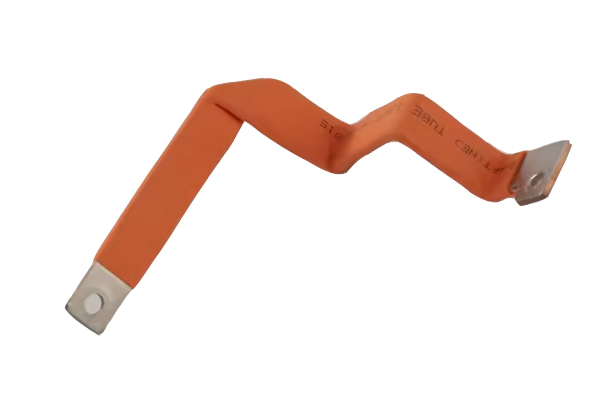
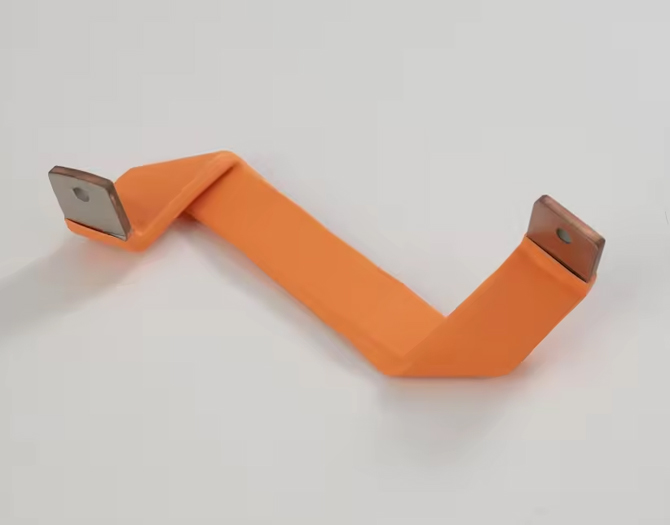
Our factory specializes in manufacturing flexible copper busbars, designed to meet the demands of diverse electrical applications. Our flexible copper busbars made of high-purity copper wire row as a conductor, combined with cable technology and new materials, designed for high-current power transmission and distribution scenarios. Its structure consists of a copper wire conductor, an insulation layer (such as PVC or polyolefin), a winding layer, a metal armor layer (aluminum alloy or copper alloy) and a sheath layer, with high flexibility, strong current-carrying capacity, and environmental adaptability. The product conforms to IP68 protection grade and is suitable for outdoor and humid environments.
| 품목 유형: | 유연한 구리 버스바 |
|---|---|
| 재료 기반: | 구리 + 니켈 |
| 정격 전류: | below 3kV AC, below 1.5kV DC. |
| Insulation resistance: | ≥15000MΩ (through the 3.5kV withstand voltage test) |
| 도체 재료: | T2 copper (purity ≥ 99.9%), optional tin-plated, nickel-plated or silver-plated treatment |
| Bending radius: | range ≥ 200-1000mm |
| 성형방법 | 스탬핑; 절연 딥 파우더 |
| 표면처리 | 원래 색상 세척; 매트 세척 |
| OEM/ODM | 사용자 정의 지원 |
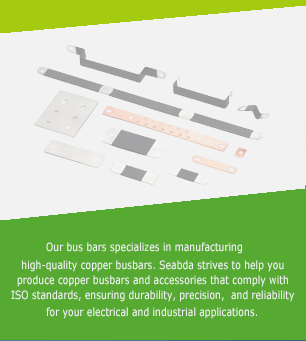
선도적인 유연한 구리 버스바 제조업체
Our factory is dedicated to producing top-quality solutions that meet stringent industry standards. Utilizing advanced technology and rigorous quality control, we ensure our busbars deliver outstanding electrical conductivity, durability, and flexibility.
Production process
1. Raw material treatment: High purity electrolytic copper is melted and rolled into copper rods or strips.
2. Conductor Forming: Copper rods are drawn and calendered to form flexible copper wire rows.
3. Insulation and armoring:
- Winding insulation material (such as mica tape)
- Add metal armor layer (aluminum alloy or copper alloy interlocking structure)
4. Sheath molding: outer layer covered with PVC, polyolefin or Santoprene (halogen-free materials).
5. Testing and packaging: Electrical performance test (voltage resistance, insulation resistance, etc.)
유연한 구리 버스바를 사용자 정의하는 방법은 무엇입니까?
유연한 구리 버스바의 선도적 제조업체로서, 우리는 고객의 고유한 요구 사항을 충족하기 위해 포괄적인 맞춤형 서비스를 제공합니다. 맞춤형 프로세스에 접근하는 방법은 다음과 같습니다.
1. Confirmation of demand: Define parameters such as current, voltage, bending radius and protection level.
2. Design selection:
- Provide drawings or the supplier to assist in the design (such as branch connector, pre-branching structure).
- Select surface treatment (plating type), insulation material (PVC/halogen-free), etc.
3. Sample production: suppliers to provide small batch sample testing (e.g., current-carrying capacity, temperature rise test).
4. Mass production: Standardized assembly line production, support for customized lengths (up to hundreds of meters).
5. Delivery and installation:
- Provide supporting accessories (conversion box, T-connector).
- Support on-site laying guidance (bridge, through the pipe, direct burial, etc.).
Typical customized cases
- New energy supercharging station: 3200A flexible busbar customized for Huawei supercharging host, realizing the integrated laying of a single busbar and reducing the loss of joints.
- Data center: Flame retardant low-smoke halogen-free busbar, meeting B1 level fire prevention standards and supporting long-distance design without intermediate joints.
유연한 구리 버스바를 사용하는 주요 이점은 무엇입니까?
- Energy efficient: no eddy current loss, excellent heat dissipation performance, line loss reduced by more than 10%.
- Convenient installation: can be transported in rolls, used as you cut, no need to customize the joints, shorten the construction cycle by 30%.
- Safe and reliable: IP68 protection, fire-resistant and flame-retardant design, adaptable to extreme environments.
- Cost optimization: standardized production to reduce material waste, low maintenance costs (maintenance-free design).
- Intelligent: support real-time monitoring of current, voltage, temperature and other parameters.
Whar are the aplication for flexible copper busbars?
- New energy: photovoltaic power stations, energy storage systems, electric vehicle supercharging stations (e.g. Huawei 600kW liquid-cooled supercharging).
- Power systems: substations, transmission and distribution networks.
- Industry and buildings: data centers (IDC), metallurgical and chemical plants, commercial complexes.
- Rail transportation: subway power supply system, high-speed rail substation.
- Ship and military: ship power system, military equipment power supply.
 Korean
  English
  Arabic
  German
  Spanish
  French
  Russian
  Danish
  Japanese
  Italian
  Vietnamese
  Turkish
  Dutch
Dutch  Portuguese
  Thai
Thai  Swedish
  Greek
Greek  Polish
  Estonian
  Esperanto
  Hindi
Hindi  Indonesian
  Latvian