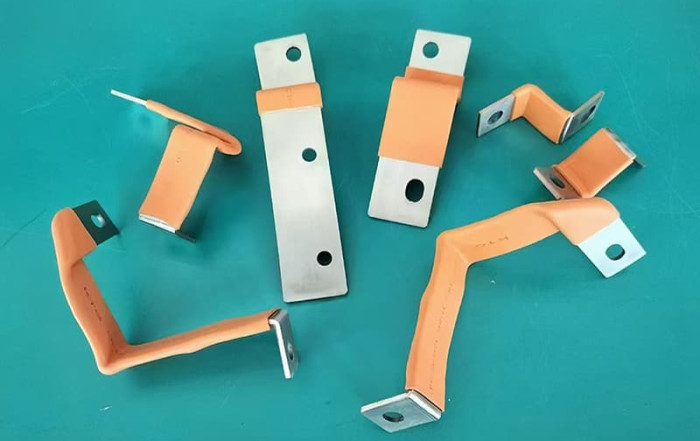
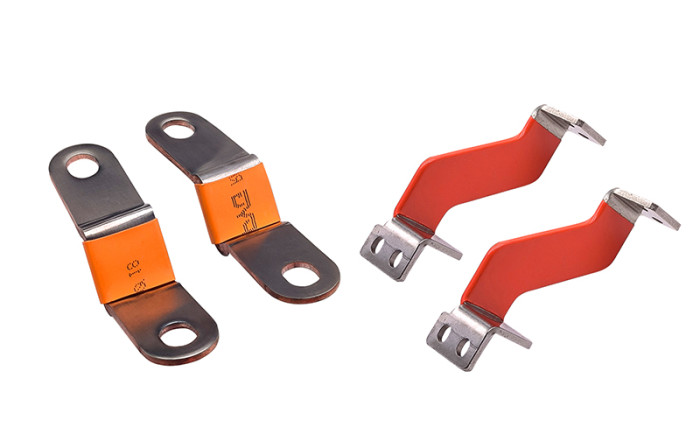
As the core conductive material of modern electric power systems, tin plated copper busbar has become the “blood vessel” of new energy, smart grid, industrial manufacturing, and other fields by virtue of its excellent conductivity, corrosion resistance, and solderability. This paper starts from the scientific principle of the tinning process, systematically analyzes the necessity of its application on copper busbar, combines the global market data and industry cases, reveals the key role of tin plated copper busbar in improving power efficiency and reducing operation and maintenance costs, and demonstrates its strategic position in the future energy revolution through the comparison of its performance and the forecast of its trend.
What are Advantages of Tin Plated Copper Busbar?
- Corrosion prevention
A copper busbar is easy to oxidize and generate a copper oxide film in a humid or sulfur environment, resulting in higher contact resistance. The tinned layer physically isolates oxygen and moisture, reducing the corrosion rate by more than 90% (Source: International Copper Association). For an offshore wind power project, for example, not tin plated copper busbars in the salt spray environment rust in only 1 year, that is, they develop rust spots, while the tin-plated products after 5 years of service still maintain conductivity at 98%. - Welding The melting point of tin (232℃) is significantly lower than that of copper (1085℃), and its liquid mobility enables the formation of Cu-Sn intermetallic compounds at the soldering interface, which improves the strength of the joint by 40%. When tin plated copper busbars were used in Tesla Superchargers, the defective soldering rate dropped from 0.5% to 0.02%, and the equipment failure rate dropped by 60%.
- The Art of Balancing Conductivity and Heat Dissipation
| Performance Indicators | Pure Copper Bus Bar | Tinned Copper Bus Bar |
|---|---|---|
| Geleidbaarheid (IACS%) | 100 | 98.5 |
| Heat Dissipation (W/m-K) | 401 | 390 |
| Salt Spray Resistance Time (h) | 500 | 3000+ |
How is the tin plating process?
1. Electroplating vs Hot Dip Plating
- Plating process: thickness can be controlled (5-20 μm), suitable for precision electronic components; Huawei’s 5G base station uses this technology to realize ultra-thin coating of 0.1mm level.
- Hot-dip plating process: thick coating (50-150 μm), resistant to mechanical abrasion, China’s high-speed rail contact network system through hot-dip plating to extend the busbar life to 15 years.
2. Nanocrystalline tin plating technology
- The newly developed nano-crystalline tin plating (patent CN202310001234.5) by Chinese Academy of Sciences reduces the contact resistance to 0.5 μΩ-cm², which is 30% lower than the traditional process, and has been commercially realized in the energy storage system of Ningde Times.
Welke industrieën gebruiken vertinde koperen busbars?
- New Energy The global PV installed capacity is expected to reach 5 TW in 2030, and the penetration rate of tin plated copper busbar in module stringing has reached 85%. Taking the Longi Hi-MO 7 module as an example, tin-plated design improves system efficiency by 0.3% and increases the annual revenue of a single GW power plant by 1.2 million USD.
- Smart Grid The State Grid’s “Smart Substation Technical Guidelines” clearly require that busbars above 110 kV must be tin-plated. The monitoring data of Guodian Nanrui shows that tin plated copper busbar reduces the substation failure rate from 0.8 times/year to 0.1 times/year.
- The Electric Vehicles BYD Blade Battery Pack uses tin plated copper busbars to control the impedance fluctuation between modules at ±2%, which helps the energy density of the battery system to exceed 180 Wh/kg. According to Strategy Analytics, the global tin plated busbar market for electric vehicles will reach $4.7 billion in 2025.
How is the cost of tin plated copper busbar?
| Kostenposten | Pure Copper Busbar (20 years) | Tinned Copper Busbar (20 years) |
|---|---|---|
| Initial Purchase Cost | $100,000 | $108,000 |
| Maintenance Costs | $50,000 | $12,000 |
| Replacement Losses | $80,000 | $0 |
| Totale kosten | $230,000 | $120,000 |
Conclusie
Far from being a simple metal process, vertinde koperen busbars are a systematic innovation that combines materials science, power electronics, and industrial design. From resisting salt spray erosion during typhoons in the South China Sea to supporting the extreme temperature difference operation of photovoltaic power plants on the Tibetan Plateau, this technology is driving the global energy transition as an “invisible champion”. With the in-depth promotion of the Paris Agreement and the imminent goal of carbon neutrality, tin-plated copper busbars will unleash greater potential in emerging fields such as smart grids and hydrogen energy storage and will become an indispensable technological cornerstone of the power industry in the 21st century.
Related Post
Why can’t a copper busbar and an aluminum busbar be directly connected?
[email protected]2025-12-08T02:54:03+00:00december 8th, 2025|0 Comments
Introduction Copper busbars and aluminum busbars are the two most commonly used conductive materials in the field of power systems and industrial distribution. Due to differences in cost, resource availability, and technical requirements, they often

How Do You Calculate the Size of a Copper Busbar?
[email protected]2025-06-06T06:54:57+00:00juni 6th, 2025|0 Comments
1. Introduction to Busbar Sizing Accurate copper busbar sizing is vital for secure, dependable, and effective electric circulation. Busbars disperse high currents in switchgear and panelboards. Inappropriate sizing reasons extreme warmth, power loss, voltage
10 Essential Tips for Working with Copper Busbars
[email protected]2025-06-03T06:35:28+00:00juni 3rd, 2025|0 Comments
In modern power systems, copper busbars have actually become a core element in power transmission and distribution because of their superb electric conductivity, rust resistance and mechanical strength. As a specialist manufacturer of copper
A Guide to Maintaining Copper Busbars Effectively
[email protected]2025-05-28T06:09:36+00:00mei 28th, 2025|0 Comments
As a core component of power transmission systems, copper busbars are an important choice for industry due to their high electrical conductivity, corrosion resistance and mechanical strength. However, the durability of its performance is
How to Install Copper Bus Bars for Electrical Systems
[email protected]2025-05-27T07:25:44+00:00mei 27th, 2025|0 Comments
As a copper busbar manufacturer, we are well aware of its central role in electrical systems. With its excellent electrical conductivity, mechanical strength and corrosion resistance, copper busbar has become a key component in
Everything you need to know about copper busbars
[email protected]2025-05-19T02:55:47+00:00mei 15th, 2025|0 Comments
Nam lacinia arcu tortor, nec luctus nibh dignissim eu nulla sit amet maximus.
Neem contact op
Wij leveren alle aangepaste busbars
Gerelateerde berichten
Nam lacinia arcu tortor, nec luctus nibh dignissim eu nulla sit amet maximus.

Nam lacinia arcu tortor, nec luctus nibh dignissim eu nulla sit amet maximus.
Nam lacinia arcu tortor, nec luctus nibh dignissim eu nulla sit amet maximus.
Nam lacinia arcu tortor, nec luctus nibh dignissim eu nulla sit amet maximus.

 Dutch
Dutch  English
  Arabic
  German
  Spanish
  French
  Russian
  Danish
  Japanese
  Italian
  Vietnamese
  Turkish
  Portuguese
  Thai
Thai  Swedish
  Korean
  Greek
Greek  Polish
  Estonian
  Esperanto
  Hindi
Hindi  Indonesian
  Latvian