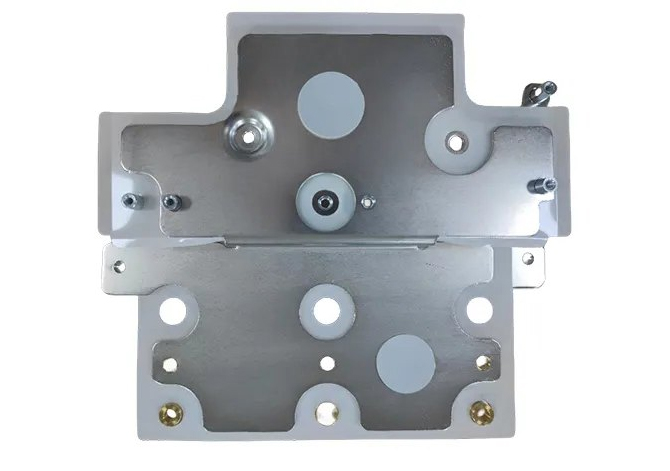
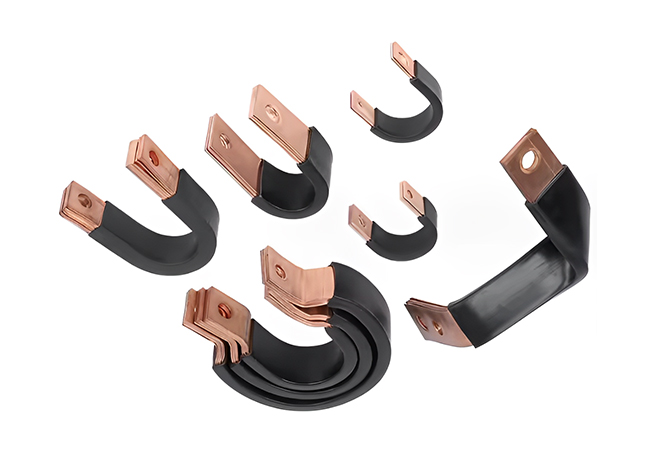
Barramento de cobre laminado OEM com revestimento Shunk
√ A construção laminada garante uma transmissão de energia eficiente.
√ Oferece robustez e resistência ao estresse mecânico.
√ Suporta altas temperaturas sem comprometer o desempenho.
√ Adequado para ambientes adversos, garantindo confiabilidade a longo prazo.
√ Disponível em vários tamanhos, formas e configurações
The laminated copper bus bars we manufacture are constructed by bonding multiple layers of high-quality copper sheets with insulating layers in between. This construction ensures excellent electrical conductivity while providing insulation to prevent short circuits and electrical faults. Laminated copper busbar is a kind of power transmission component made of multiple layers of thin copper plates (or copper foils) and insulating materials alternately stacked by high temperature and high pressure process. Its core design optimizes the conductor structure to reduce the skin effect and improve the current-carrying capacity, while reducing the energy loss and material consumption, which is widely used in high-current and high-reliability power systems.
| Tipo de item | Barramento de cobre laminado |
|---|---|
| Padrão de material | C11000 cobre |
| Revestimento | estanhagem, niquelagem, prateação |
| Espessura de folha única | 0,05 mm – 0,3 mm |
| Revestimento Isolado | tubo termoencolhível |
| Dielectric strength: | 20kV/mm (PTFE insulation). |
| Espessura do revestimento | 3-5 μm |
Fabricante líder de barramentos de cobre laminado
Somos fabricantes de barramentos de cobre laminado, especializados em soluções personalizadas para atender a uma ampla gama de necessidades elétricas e mecânicas. Nossa fábrica de ponta é equipada com tecnologia avançada e conta com uma equipe experiente, garantindo produção de alta qualidade e engenharia precisa. Atendemos a vários setores, fornecendo barramentos confiáveis e eficientes que melhoram tanto o desempenho quanto a segurança.
Laminated copper bus bar Production Process:
Barramentos de cobre laminado podem ser classificados com base em vários fatores, como tamanho, formato e configuração. Algumas classificações comuns incluem:
- Material Preparation: Copper foil/copper plate cut to required size, insulation material (e.g. epoxy resin film) cut.
- Lamination molding: Alternate stacking of copper and insulating layers, through the hot press high temperature (such as 200 ℃ ~ 300 ℃) and high pressure (such as 20MPa) curing.
- Welding and connection: Use molecular diffusion welding or pressure welding process to fix the contact surface.
- Tratamento de superfície: Passivation treatment (anti-oxidation), tin/silver plating (enhance conductivity), epoxy coating (anti-corrosion).
- Bending and Testing: Specialized bending machine molding, and through the load capacity, voltage resistance, temperature rise and other tests.
Vantagens do barramento de cobre laminado:
- High performance: Skin effect optimization, 53% increase in current-carrying capacity compared with solid copper rows, 10% to 20% reduction in loss.
- Light weight and environmental protection: Copper consumption is reduced by 30%~50%, in line with low-carbon requirements.
- Excellent heat dissipation: The multi-layer structure accelerates heat diffusion, and the temperature rise is 20% lower than that of traditional busbar.
- Compact structure: Compact size: 50% less space than cable, suitable for small environments (e.g. data centers).High reliability:
- High reliability: vibration-resistant, short-circuit-resistant (63kA/4s), with a life span of more than 20 years.
Laminated copper bus bar application:
- Power system: Substation main busbar, distribution cabinet busbar.
- New energy: PV/wind farm power transmission, electric vehicle battery pack connection.
- Industrial equipment: High-current equipment such as frequency converters, welding machines, machine tools, etc.
- Transporte ferroviário: High-speed rail/subway power system, signaling system power supply.
- Data Center: Efficient power distribution for server clusters.
Perguntas frequentes sobre barramentos de cobre laminado
Q1: What is the difference between laminated copper busbar and traditional copper busbar?
A1: Laminated structure reduces the skin effect through thin copper plate stacking, higher current carrying capacity, lower loss, and lighter weight.
Q2:What are the advantages of flexible laminated busbar?
A2: It can be bent and installed to adapt to the complex space, and can compensate for equipment installation errors, suitable for electric vehicle charging pile and other scenarios.
Q3:How to choose the insulation material of laminated busbar?
A3: Choose according to the temperature demand, such as PTFE (high temperature resistant), epoxy resin (high mechanical strength) or silicone rubber (flexible).
Q4: Key points for quality control in production?
A4:Copper purity (≥99.95%), lamination uniformity, welding strength and insulation layer dielectric properties need to be tested.
Q5: Is laminated busbar suitable for outdoor environment?
A5: Yes. With IP67 protection design and UV-resistant coating, it can adapt to humid, dusty and other harsh conditions.
For more detailed technical parameters or customized solutions, please contact our team.

 Portuguese
  English
  Arabic
  German
  Spanish
  French
  Russian
  Danish
  Japanese
  Italian
  Vietnamese
  Turkish
  Dutch
Dutch  Thai
Thai  Swedish
  Korean
  Greek
Greek  Polish
  Estonian
  Esperanto
  Hindi
Hindi  Indonesian
  Latvian