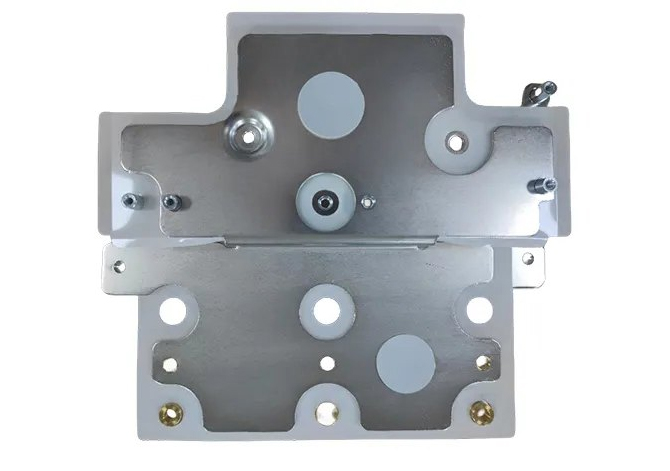
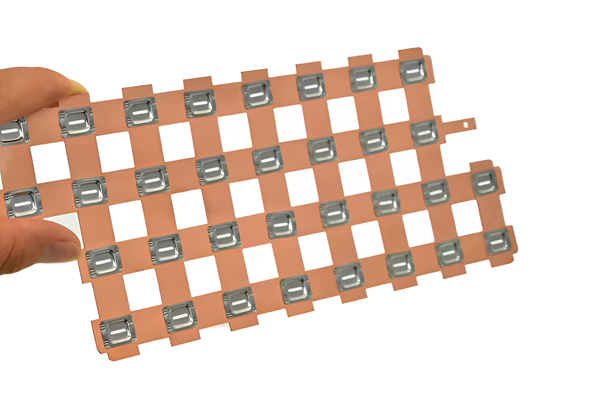
Barramento de bateria de lítio de cobre 18650/21700/32650 personalizado
√ Compatível com células 18650, 21700 e 32650 para diversas configurações.
√ Tolerâncias rigorosas para ajuste preciso e conexões confiáveis.
√ Excelente dissipação de calor para maior segurança e desempenho.
√ Fortes propriedades mecânicas para uma montagem robusta do conjunto de baterias.
Nosso barramento de bateria de lítio é projetado especificamente para uso em células de bateria de lítio 18650, 21700 e 32650, garantindo distribuição de energia eficiente e desempenho superior em conjuntos de bateria. Feitos de cobre de alta pureza, esses barramentos oferecem excelente condutividade elétrica e térmica, tornando-os ideais para aplicações de alta corrente em veículos elétricos, sistemas de armazenamento de energia e vários eletrônicos de consumo.
| Tipo de item: | barramento de bateria de lítio |
|---|---|
| Base material: | Cobre, niquelagem e niquelagem, etc. |
| Grossura: | Personalizável (opções padrão: 0,10 mm, 0,15 mm, 0,20 mm, 0,25 mm) |
| Largura: | Personalizável para se adaptar a configurações de células específicas |
| Comprimento: | Adaptado ao design do pacote de bateria |
| Aplicativo: | Pacote de bateria |
| Temperatura de operação: | -40°C a +120°C |
| Resistência à tração: | ≥ 250 MPa |
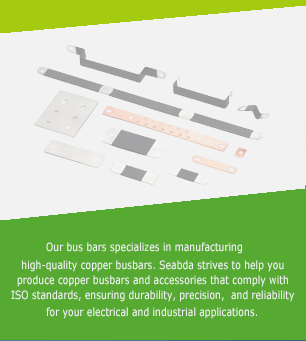
Fabricante líder de barramentos para baterias de lítio
How to customize lithium battery busbar?
The function of a lithium battery busbar is to realize efficient and stable current transmission between battery cells. Customized design has become an industry trend according to the differences in cell models and application scenarios.
- Adaptability of battery cells: 18650, 21700, 32650 and other mainstream battery cells need to be matched with busbars of different sizes and current-carrying capacity (e.g. 21700 busbar supports high rate discharge for electric vehicles)[^User’s original article].
- Optimization of connection methods: Spot welding type is suitable for automated production lines (efficiency increased by 30%), and bolt type facilitates modular maintenance (after-sales cost reduced by 20%)[^User Original Article].
Comparison of mainstream cell busbar performance
| Types | Current Carrying Capacity (A) | Aplicativo | Advantages |
|---|---|---|---|
| 18650 | 50-80 | Eletrônicos de consumo | Lightweight and Low Cost |
| 21700 | 100-150 | Veículos elétricos | High multiplication, high temperature resistance |
| 32650 | 200-300 | Industrial energy storage | High current, long life |
What material we will use for lithium battery busbars?
The choice of busbar material has a direct impact on battery pack efficiency and safety:
- Pure copper vs. copper alloy: pure copper has a high conductivity of 58 MS/m but insufficient tensile strength (150 MPa); copper alloys (e.g., C18150) have their strength increased to 400 MPa by adding chromium and zirconium, making them suitable for vibration environments[^User’s original article].
- Surface plating technology: nickel plating (corrosion resistance increased by 50%), silver plating (contact resistance reduced by 15%) and other processes to extend the busbar life, suitable for high humidity or salt spray environment.
How is the manufacturing process for lithium battery busbars?
High-end busbars need to meet ±0.1 mm tolerance requirements, and the innovation of manufacturing processes is crucial:
- Laser cutting and stamping: Compared with the traditional etching process, the efficiency is increased by 3 times and the edge burr is reduced by 90%.
- Intelligent inspection system: online inspection based on machine vision can control the defective rate below 0.5%.
What is the application for lithium battery busbars?
The demand for lithium battery busbars continues to grow with the outbreak of downstream industries:
- Electric Vehicles: 50-100 pieces of busbars are needed for a single EV, and the global market size is expected to reach $12 billion in 2025 (CAGR 25%).
- Energy storage system: photovoltaic energy storage bus bar requires temperature resistance (-40 ℃ to 85 ℃), and China’s installed capacity of energy storage in 2023 exceeded 30 GWh.
- Industrial Robotics: High vibration-resistant busbar helps AGV equipment range increase by 20%.
How is the testing systems for our lithium battery busbars?
International standardsand domestic specifications (GB/T 31467) put forward strict requirements on current-carrying, insulating, and flame-retardant properties of busbars:
- Thermal runaway test: need to pass 150% overload current test without fusing.
- Full life cycle monitoring: Intelligent BMS systems monitor the busbar temperature rise and aging in real time.
Environmental Protection and Sustainability:
The EU’s New Battery Law requires busbar materials to have a recyclability rate of more than 90%, which promotes the technological transformation of the industry:
- Lead-free plating process: tin-bismuth alloy replaces traditional tin plating, reducing heavy metal pollution (10% increase in cost, but improved compliance).
- Lightweight design: Reduce copper usage by 15% through topology optimization to reduce carbon emissions (Tesla 4680 battery case) [^User Original Article].
Cost competition:
Busbar cost accounts for 5%-8% of the total cost of a battery pack, and the path of cost reduction includes:
- Flexible production line: the same production line is compatible with multi-size products (YWL’s production capacity increased by 50%) [^User’s original article].
- Domestic substitution: the local supply ratio of high-purity copper strips increased from 40% to 70% (Jiangxi Copper’s technological breakthrough).
8. Future technology trends:
Solid-state battery puts new demands on busbar:
- High-voltage-resistant design: support operating voltage above 4.5 V (3.7 V for traditional lithium batteries) [^User Original Article].
- Integrated Sensors: Embedded temperature/strain sensors for health status prediction (Bosch R&D in progress).
Resumo
Li-ion battery busbar technology is evolving from a “single conductive component” to a “systematic solution”. The combination of customized design, material innovation, and smart manufacturing will continue to drive the industry’s upgrading. Enterprises need to keep up with the demands of downstream markets (e.g., EV, energy storage) and strengthen technical barriers and compliance capabilities in order to take the lead in global competition. In the future, with the popularization of solid-state batteries and Internet of Things (IoT) technology, busbars may evolve into “intelligent energy transmission units”, opening up a new round of industrial revolution.

 Portuguese
  English
  Arabic
  German
  Spanish
  French
  Russian
  Danish
  Japanese
  Italian
  Vietnamese
  Turkish
  Dutch
Dutch  Thai
Thai  Swedish
  Korean
  Greek
Greek  Polish
  Estonian
  Esperanto
  Hindi
Hindi  Indonesian
  Latvian