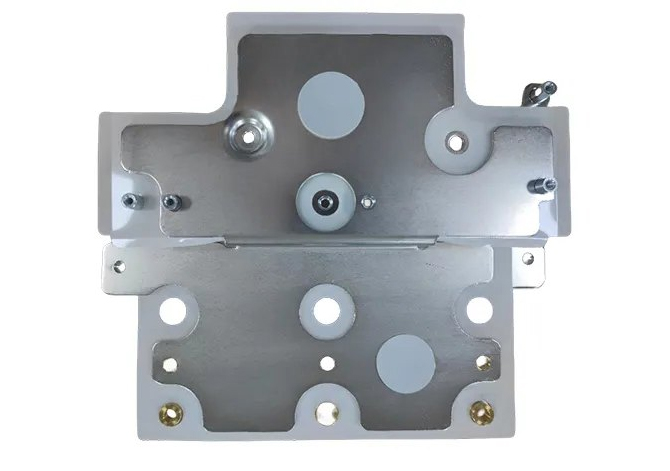
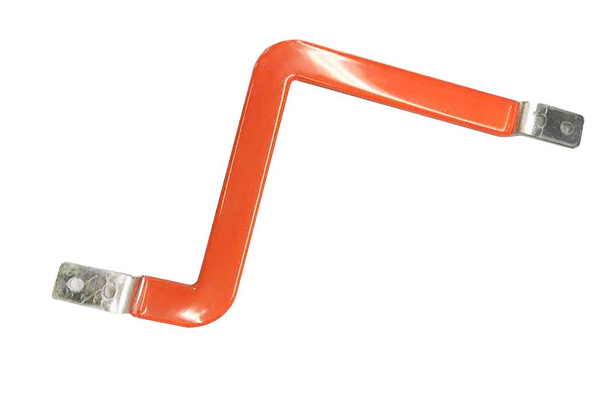
Barramento laminado de folha de cobre personalizado
√ Excelente condutividade elétrica para transmissão de energia eficiente.
√ A flexibilidade permite fácil modelagem e dobra.
√ Construção robusta garante durabilidade e resistência à vibração.
√ Estabilidade térmica para operação confiável em ambientes exigentes.
√ Disponível em vários tamanhos e configurações para diferentes aplicações.
As a manufacturer of laminated bus bars, we focus on delivering customized solutions for a wide range of electrical and mechanical needs. Our cutting-edge facility features advanced technology, and our skilled team ensures top-notch production and precise engineering. Its typical features include:
- Structural design: thin and wide copper/aluminum foils (0.05-1.5 mm thick) are precisely laminated with insulating materials to form a “sandwich” structure;
- Electromagnetic optimization: adjacent conductive layers are designed to offset magnetic fields through reverse current, significantly reducing parasitic inductance (more than 60% compared to traditional busbars);
- Core technology: hot press molding technology (120-200 ℃, high pressure) to achieve the conductive – insulating interface of the molecular level combination.
| Tipo de item | barra de ônibus laminada |
|---|---|
| Material: | Condutores de cobre ou alumínio laminados com materiais isolantes |
| Conductor Thickness: | 0.05mm~1.5mm (supports ultra-thin to heavy-duty designs) |
| Espessura do isolamento: | 0,05 mm a 0,5 mm. |
| Largura: | 5 mm a 200 mm. |
| Flexibilidade: | Permite flexão sem comprometer o desempenho. |
| Classificação de temperatura: | -40°C a +150°C. |
| Classificação de voltagem: | Adequado para aplicações de baixa a média tensão. |
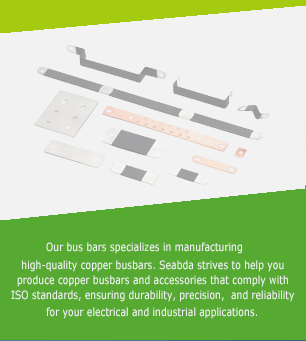
Seu principal fabricante de barras de ônibus laminadas
As a manufacturer of laminated busbars, we are committed to providing highly customized electrical connection systems to our customers worldwide. With fully automated precision production lines and an experienced R&D team, we have achieved breakthroughs in everything from material science to structural design to create conductive solutions that combine high performance with high safety.
O que é uma barra de ônibus laminada?
Adopting multi-layer composite lamination process, the conductive layer (copper/aluminum) is alternately laminated with high-performance insulating materials such as polyimide (Kapton) and polyester (Mylar), which are integrally molded by high temperature and high pressure to achieve:
✅ Ultra-low impedance: parallel distribution of conductive layers reduces eddy current losses and lowers resistance by 40%+.
✅ Intelligent Heat Dissipation: Multi-layer interfaces form a heat transfer matrix that controls temperature rise better than industry standards.
✅ Dynamic Flexibility: Three-dimensional moldable design supports complex spatial wiring (bending life >100,000 times).
Por que os barramentos são laminados?
Busbars are laminated to enhance flexibility, reduce resistance, improve heat dissipation, enhance insulation, and allow for customization. By sandwiching conductive layers between insulating materials, laminated busbars offer efficient power transmission, minimize the risk of short circuits, and provide excellent dielectric properties.
1. electrical performance jump
- Low resistance: The multi-layer parallel structure increases the current carrying capacity per unit cross-section area by 3 times;
- Low inductance: Reverse current magnetic field canceling effect reduces inductance to 1/5 of conventional structures;
- Anti-interference: shielding effect reduces electromagnetic noise (applicable to sensitive scenarios such as inverters and data centers).
2. Thermal management revolution
- Multi-layer interface to form a heat conduction matrix, heat dissipation efficiency increased by more than 40%;
- Uniform current distribution eliminates localized hot spots (e.g. electric vehicle battery pack temperature difference can be controlled within ±2℃).
3. Space and reliability breakthrough
- Compactness: the volume is 70% smaller than traditional busbar under the same current-carrying capacity;
- Vibration-resistant: the integrated structure is certified by IEC 61439 and is resistant to salt spray corrosion for 2000 hours.
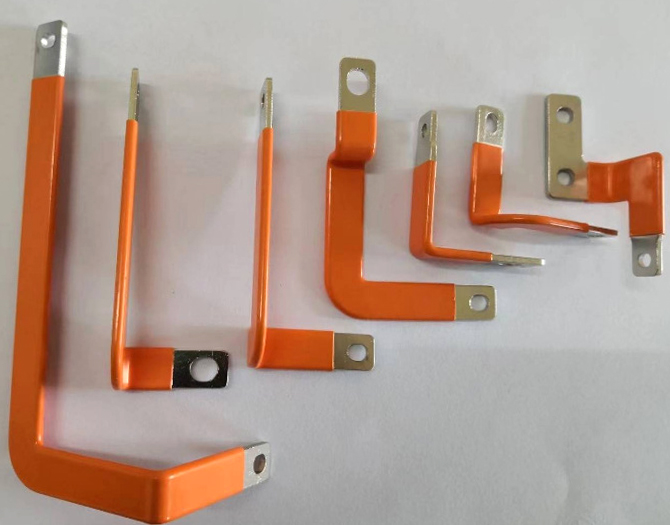
Qual é a diferença entre laminação e isolamento?
| Dimension | Lamination | Isolamento |
|---|---|---|
| Purpose | Composite Structures | imply Blocking Current |
| Process Characteristics | epoxy/SMC materials | Surface coating (e.g., nanocoatings) |
| Structural Complexity | Alternating Multilayer Stacking | Single or Multilayer Simple Covering |
| Functional Integration | Integration of conductive, thermal and mechanical support | Single electrical isolation function |
| Aplicações | High Frequency Inverters, Electric Vehicle Electric Drive Systems | Cable Sheathing, Terminal Protection |
Barramentos laminados oferecem diversas vantagens:
1. Superconductivity
- Copper layer purity ≥ 99.99%, conductivity 58MS/m;
- High-frequency scenarios (such as photovoltaic inverters) power loss reduced by 60%.
2. Dynamic flexibility
- Three-dimensional bendable (minimum bending radius 3 times the thickness);
- Bending life >100,000 times (for robot joint wiring).
3. Environmental adaptability
- Operating temperature -40℃~+150℃;
- UL94 V-0 flame retardant certification.
4. Safety Barrier
- Interlayer breakdown strength ≥300V/μm;
- Arc failure rate reduced by 90% (compared with traditional switchgear).
5. Full Scenario Adaptation
- Voltage coverage 600V~35kV;
- New energy (PV/energy storage), rail transportation, industry 4.0 and other cross-field applications.
Get Customized Solutions Now
Whether you need high-frequency, low-inductance busbars, ultra-thin flexible conductors, or high-temperature-resistant specialty models, our engineering team will provide a technical response within 24 hours. Submit your requirements and unlock the performance limits of next-generation electrical connection systems!

 Portuguese
  English
  Arabic
  German
  Spanish
  French
  Russian
  Danish
  Japanese
  Italian
  Vietnamese
  Turkish
  Dutch
Dutch  Thai
Thai  Swedish
  Korean
  Greek
Greek  Polish
  Estonian
  Esperanto
  Hindi
Hindi  Indonesian
  Latvian