There is a growing demand for connecting aluminum conductors to медные шины in power systems, new energy equipment, and industrial applications. However, the differences in the physical and chemical properties of the two metals may lead to problems such as galvanic corrosion and elevated contact resistance. Based on industry specifications and experimental data, this paper analyzes the five core challenges of aluminum-copper connections and provides practical solutions to help achieve safe, reliable, and long-life cross-metal connections.
Challenges of aluminum-copper connections
- Electrochemical corrosion: metal oxidation caused by the primary battery effect
When aluminum (standard electrode potential -1.66V) and copper (+0.34V) are in direct contact, a primary cell is formed in a humid environment, and aluminum acts as an anode to accelerate corrosion, resulting in higher contact surface resistance. Experiments show that for the untreated aluminum-copper joints in the salt spray test, the temperature rise can reach more than 200 ℃. - Difference in coefficient of thermal expansion: stress relaxation and contact failure
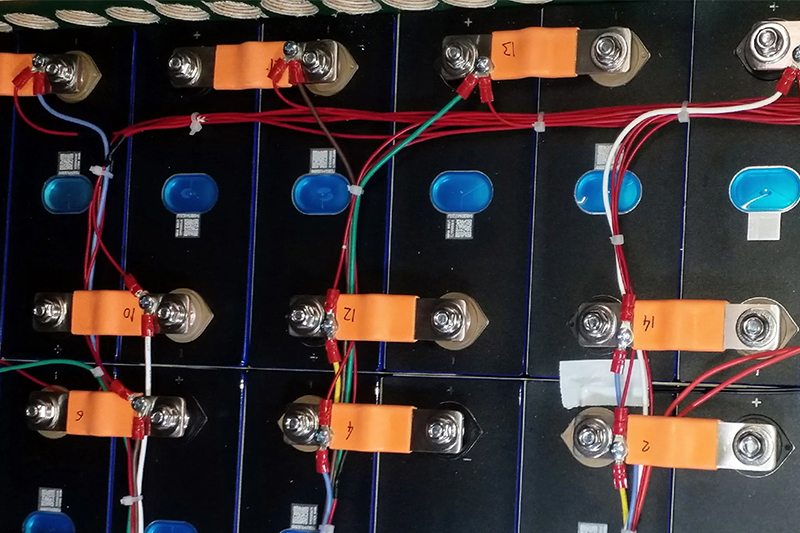
The coefficient of thermal expansion of aluminum (23.1 x 10-⁶/ °C) is 1.4 times higher than that of copper (16.5 x 10-⁶/ °C). Temperature fluctuations can lead to microgaps at the connection interface and elevated contact resistance, triggering localized overheating or even fusion (Figure 1). - Oxide film impedance: formation of highly resistive layers on aluminum surfaces
Aluminum exposed to air will quickly generate an aluminum oxide (Al₂O₃) film; its resistivity is as high as 10¹⁴ Ω-cm, which is 1,000 times that of a copper oxide film. If not removed, the joint resistance will increase by 30%-50%. - Difference in creep performance: mechanical failure under long-term loads
Aluminum’s creep strength is only 60% of copper’s. Long-term vibration or high current loads are prone to plastic deformation, leading to loosening of bolted joints (Figure 1). - Balancing Cost and Process: Technical Options for Lightweighting Needs
Aluminum conductors are 60% lighter than copper, but the connection process costs 20%-40% more (Table 1). Economy and reliability need to be weighed according to the scenario.
Comparison of copper and aluminum physical properties
| Параметры | Copper (C1100) | Aluminum (6101-T6) |
|---|---|---|
| Conductivite (%IACS) | 100 % | 55 % |
| Плотность (г/см³) | 8,96 | 2,70 |
| Coefficient of thermal expansion (×10-⁶/°C) | 16.5 | 23.1 |
| Tensile Strength (MPa | 220 | 180 |
| Typical Application Cost Ratio | 1.0 | 0,6-0,8 |
Six-step standardized process
Step 1: Select Specialized Transition Connectors
- Copper and aluminum transition terminals: Composite joints with friction welding or ultrasonic welding processes can isolate electrolyte penetration and reduce the risk of corrosion.
- Plating treatment: tin-lining (Sn-0.14V) or silver-plating (Ag+0.80V) on the copper end to narrow the potential difference with aluminum to less than 0.8V (original copper-aluminum difference of 2.0V).
Step 2: Surface pretreatment and antioxidant
- Mechanical grinding: use 120-grit sandpaper to remove the oxide film on the aluminum surface and control the roughness of the contact surface at Ra≤3.2μm.
- Chemical treatment: Spray conductive paste containing zinc chromate to fill microscopic voids and block oxygen.
Step 3: Precise torque control and anti-loosening design
- Bolt size: Recommended torque of 10-12 N-m for M8 bolts, with disc spring washers to compensate for thermal expansion (Figure 2).
- Contact pressure monitoring: Determine the critical value (ΔR/Δσ<-0.1μΩ/MPa) by resistance-stress curve.
Step 4: Welding process selection
- Friction Stir Welding (FSW): Suitable for large cross-section connections with joint strengths up to 90% of the base material.
- Laser brazing: Use Zn-Al brazing material (melting point 380°C) to avoid brittle CuAl₂ phase generation.
Step 5: Insulation and protection
- Double-layer protection: inner layer wrapped with silicone rubber self-fusing tape, outer layer of thickened heat-shrinkable tubing (temperature resistance 125℃) to block moisture and salt spray.
Step 6: Regular Inspection and Maintenance
- Infrared Thermal Imaging: Quarterly inspections; the temperature rise of joints needs to be lower than ambient 30℃ (IEC 61439-1 standard).
- Corrosion assessment: Measure contact resistance using the four-probe method, with an increase of more than 20% requiring re-treatment.
Industry Cases
- High-voltage wiring harness for electric vehicles: a car company adopts a silver-plated aluminum row + copper terminal solution, with a temperature rise of only 15 ℃ after 96 hours of salt spray test, and life expectancy increased by 3 times.
- Photovoltaic inverter connection: 10-year failure rate dropped from 12% to 1.5% for a system using copper-aluminum transition terminals (TÜV Rheinland report).
Заключение
The technical difficulties of aluminum-copper connection can be solved by material innovation and process optimization:
- Give priority to the use of copper and aluminum transition parts to avoid direct contact.
- Surface treatment and torque control are the core of corrosion prevention and anti-relaxation.
- Regular monitoring can provide early warning of potential failures.
Категории продуктов
Связанный пост
Why can’t a copper busbar and an aluminum busbar be directly connected?
[email protected]2025-12-08T02:54:03+00:00Декабрь 8th, 2025|0 Comments
Introduction Copper busbars and aluminum busbars are the two most commonly used conductive materials in the field of power systems and industrial distribution. Due to differences in cost, resource availability, and technical requirements, they often

Как рассчитать размер медной шины?
[email protected]2025-06-06T06:54:57+00:00Июнь 6th, 2025|0 Comments
1. Введение в определение размеров шин. Точный расчет размеров медных шин критически важен для безопасной, надежной и эффективной циркуляции электроэнергии. Шины рассеивают высокие токи в распределительных устройствах и щитах. Неправильный расчет размеров приводит к сильному нагреву, потерям мощности и перепадам напряжения.
10 основных советов по работе с медными шинами
[email protected]2025-06-03T06:35:28+00:00Июнь 3rd, 2025|0 Comments
В современных энергосистемах медные шины стали ключевым элементом систем передачи и распределения электроэнергии благодаря своей превосходной электропроводности, стойкости к ржавчине и механической прочности. Являясь специализированным производителем медных шин,
Руководство по эффективному обслуживанию медных шин
[email protected]2025-05-28T06:09:36+00:0028 мая 2025 г.|0 Comments
Медные шины, являясь основным компонентом систем электропередачи, являются важным выбором для промышленности благодаря своей высокой электропроводности, коррозионной стойкости и механической прочности. Однако их долговечность ограничена.
Как установить медные шины для электрических систем
[email protected]2025-05-27T07:25:44+00:0027 мая 2025 г.|0 Comments
Как производитель медных шин, мы прекрасно понимаем их ключевую роль в электрических системах. Благодаря превосходной электропроводности, механической прочности и коррозионной стойкости медные шины стали ключевым компонентом в
Все, что вам нужно знать о медных шинах
[email protected]2025-05-19T02:55:47+00:0015 мая 2025 г.|0 Comments
Nam lacinia arcu tortor, nec luctus nibh dignissim eu nulla sit amet maximus.
Свяжитесь с нами
Мы поставляем любые индивидуальные шины
Похожие посты
Nam lacinia arcu tortor, nec luctus nibh dignissim eu nulla sit amet maximus.

Nam lacinia arcu tortor, nec luctus nibh dignissim eu nulla sit amet maximus.
Nam lacinia arcu tortor, nec luctus nibh dignissim eu nulla sit amet maximus.
Nam lacinia arcu tortor, nec luctus nibh dignissim eu nulla sit amet maximus.

 Russian
  English
  Arabic
  German
  Spanish
  French
  Danish
  Japanese
  Italian
  Vietnamese
  Turkish
  Dutch
Dutch  Portuguese
  Thai
Thai  Swedish
  Korean
  Greek
Greek  Polish
  Estonian
  Esperanto
  Hindi
Hindi  Indonesian
  Latvian