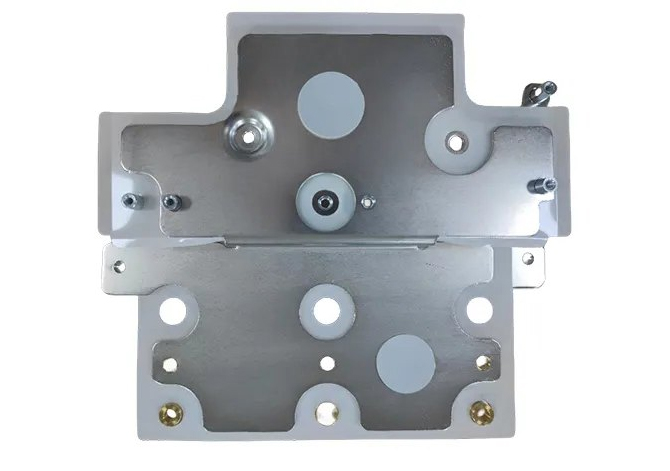
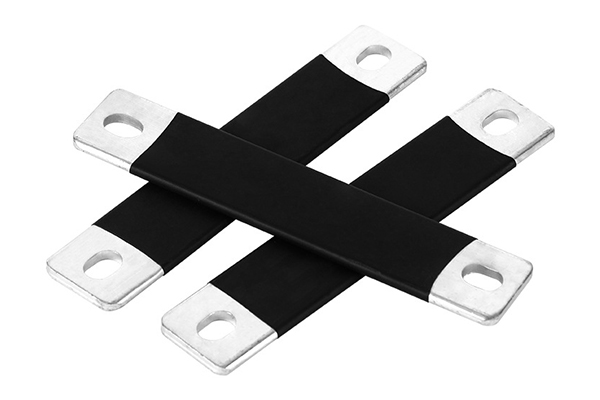
Our factory nickel-plated copper busbar is a conductive material that is uniformly covered with a layer of nickel metal on the surface of high-purity copper through the electroplating process and is widely used in high-demand scenarios such as power transmission, new energy equipment (e.g., batteries, photovoltaics), rail transportation, and communication base stations. Its core advantage lies in combining the high conductivity of copper with the corrosion resistance of nickel, which is suitable for harsh environments such as humidity, high temperature, and chemical corrosion.
| ประเภทสินค้า | บัสบาร์ทองแดงชุบนิกเกิล |
|---|---|
| วัสดุฐาน: | High purity electrolytic copper (purity ≥ 99.95%) nickel plating (nickel layer thickness 5-20μm) |
| การเคลือบ: | Nickel layer bonding ≥ 5N/mm², surface hardness HV200-300 |
| แรงดันไฟฟ้าที่กำหนด: | 250V-600V (depending on the model) |
| ค่าการนำไฟฟ้า: | ≥10V |
| ความยาว: | ปรับแต่งได้โดยทั่วไปสูงสุด 6 เมตร |
| ค่าการนำไฟฟ้า: | ≥ 98% IACS (มาตรฐานทองแดงอบอ่อนสากล) |
| ความต้านทาน: | ≤ 0.017241 โอห์ม·มม.²/ม. |
| ความต้านทานแรงดึง: | 200-400 MPa (ขึ้นอยู่กับเกรดทองแดงเฉพาะ) |
| การยืดตัว: | 30-45% |
| การนำความร้อน: | 385 วัตต์/ม.·เคลวิน |
| ช่วงอุณหภูมิในการทำงาน: | -65℃ to 260℃ (long-term use), short-term temperature resistance up to 300℃ |
| ความหนาของนิกเกิล: | โดยทั่วไป 1-10 ไมครอน |
| การยึดเกาะ: | พันธะที่แข็งแรงและสม่ำเสมอต่อพื้นผิวทองแดง |
| ความต้านทานการกัดกร่อน: | ป้องกันการกัดกร่อนและออกซิเดชั่นได้ดีเยี่ยม |
ผู้ผลิตบัสบาร์ทองแดงชุบนิกเกิลชั้นนำของคุณ
ในฐานะผู้ผลิตชั้นนำ โรงงานของเรามีความเชี่ยวชาญในการผลิตบัสบาร์ทองแดงชุบนิกเกิลคุณภาพสูงเพื่อการจ่ายพลังงานที่มีประสิทธิภาพและเชื่อถือได้ บัสบาร์ทองแดงของเราทำจากทองแดงบริสุทธิ์สูงและเคลือบด้วยชั้นนิกเกิลที่ทนทาน ออกแบบมาให้ตรงตามความต้องการที่เข้มงวดของการใช้งานในอุตสาหกรรมและเชิงพาณิชย์ต่างๆ
Production Process of nickel plate copper bus bar:
1. Copper wire preparation:
Adopt high-purity electrolytic copper through drawing and stranding processes to process it into the required diameter of copper wire, with tolerance control within ± 0.005mm.
2. Surface treatment:
Copper wire by ultrasonic cleaning and acid washing (such as with sulfamic acid) to remove surface oil and oxides.
3. Electroplating nickel layer:
Adopt the electroplating or chemical plating process, and control the current density (2-5A/dm²), temperature (50-60℃) and pH (3.5-5.5) to form a uniform and dense nickel layer.
4. Post-treatment:
Annealing to eliminate internal stress, ultrasonic cleaning to remove residues, drying and testing of coating thickness, bonding force, and other indicators.
5. Quality Inspection:
The use of high-precision instruments to detect the conductivity, plating uniformity, and corrosion resistance (such as salt spray test).
ทำไมบัสบาร์ถึงชุบนิกเกิล?
1. Corrosion resistance:
Nickel in the humid, salt spray environment can form a passivation film, preventing oxidation of the copper substrate, prolonging the life of the busbar.
2. Reduce contact resistance:
The nickel layer has a smooth surface, which reduces the roughness of the contact surface and avoids the elevated resistance caused by oxidized copper and improves the efficiency of current transmission.
3. Abrasion resistance:
Nickel hardness (HV200-300) is much higher than copper (HV40-60), suitable for sliding contact scenarios (e.g. drawer cabinet connectors).
4. Solderability:
The nickel plating layer is stable at high temperature, superior to tin plating (easy to produce tin whiskers), and suitable for high-frequency welding processes.

ทองแดงชุบนิกเกิลใช้ทำอะไร?
With its high electrical conductivity, corrosion resistance, and abrasion resistance, nickel-plated copper is widely used in electronic communications, new energy, industrial manufacturing, and other fields: in electronic communications, it is used in 5G equipment, high-frequency circuit boards, and precision sensors to ensure the stable transmission of signals; in the new energy automotive and photovoltaic industries, it is used as a battery connector and high-voltage conductor to adapt to high temperatures, salt spray, and other harsh environments; and it is used for abrasion-resistant mechanical parts and chemical pipelines to resist friction and cost in the industry.
With the development of 5G, electric vehicles, and other industries, the application of nickel-plated copper will continue to expand in scenarios that require high conductivity and durability.
ทองแดงชุบนิกเกิลดีกว่าทองแดงไหม?
ในฐานะผู้ผลิต เราตระหนักดีว่าความเหมาะสมของทองแดงชุบนิกเกิลเมื่อเทียบกับทองแดงเปล่าขึ้นอยู่กับข้อกำหนดการใช้งานเฉพาะ ทองแดงชุบนิกเกิลมีข้อดีในแง่ของความต้านทานการกัดกร่อนที่เพิ่มขึ้น ป้องกันการเกิดออกซิเดชัน และความทนทานที่เพิ่มขึ้นเมื่อเทียบกับทองแดงเปล่า ข้อดีเหล่านี้ทำให้ทองแดงชุบนิกเกิลเหมาะอย่างยิ่งสำหรับการใช้งานที่คาดว่าจะสัมผัสกับสภาพแวดล้อมที่รุนแรง สารกัดกร่อน หรือการใช้งานเป็นเวลานาน อย่างไรก็ตาม ทองแดงเปล่าอาจได้รับการเลือกสำหรับการใช้งานที่เน้นความคุ้มทุนหรือความต้านทานไฟฟ้าขั้นต่ำ ในท้ายที่สุด การเลือกระหว่างทองแดงชุบนิกเกิลและทองแดงเปล่าขึ้นอยู่กับปัจจัยต่างๆ เช่น สภาพแวดล้อม ความคาดหวังด้านประสิทธิภาพ และข้อจำกัดด้านงบประมาณ
| Characteristics | Nickel-plated copper | Pure copper |
|---|---|---|
| Electrical Conductivity | Slightly lower (higher nickel resistivity) | Excellent (conductivity ≥100% IACS) |
| ความต้านทานการกัดกร่อน | Excellent (resistant to oxidation, acids and alkalis) | Medium (easily oxidized to produce copper green) |
| Mechanical Strength | สูง | ปานกลาง |
| Environment | High humidity, high salt spray, high temperature | Dry, non-corrosive environment |
| Costs | สูง | ต่ำ |

 Thai
Thai  English
  Arabic
  German
  Spanish
  French
  Russian
  Danish
  Japanese
  Italian
  Vietnamese
  Turkish
  Dutch
Dutch  Portuguese
  Swedish
  Korean
  Greek
Greek  Polish
  Estonian
  Esperanto
  Hindi
Hindi  Indonesian
  Latvian