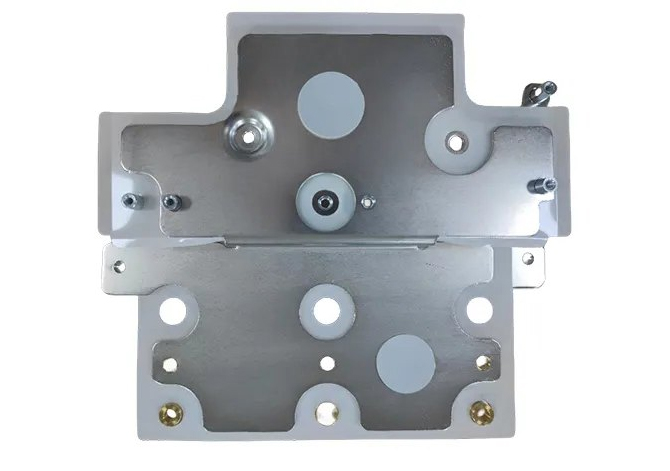
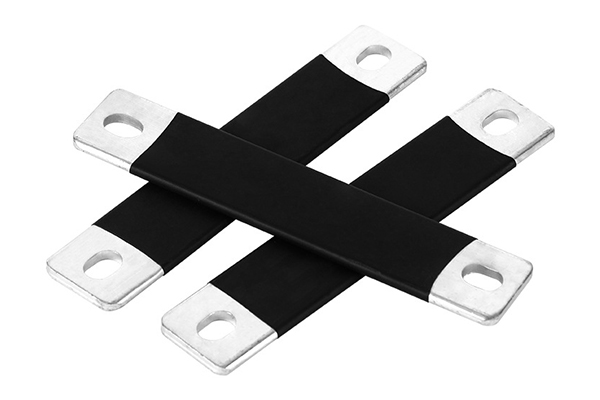
Sammelschiene aus vernickeltem Kupfer
√ Hervorragende elektrische Leitfähigkeit für eine effiziente Energieverteilung
√ Verbesserte mechanische Festigkeit und Verschleißfestigkeit.
√ Verhindert Oxidation und sorgt für eine gleichbleibende Leistung.
√ Zuverlässige Leistung über einen weiten Temperaturbereich.
√ In verschiedenen Größen und Konfigurationen erhältlich.
Our factory nickel-plated copper busbar is a conductive material that is uniformly covered with a layer of nickel metal on the surface of high-purity copper through the electroplating process and is widely used in high-demand scenarios such as power transmission, new energy equipment (e.g., batteries, photovoltaics), rail transportation, and communication base stations. Its core advantage lies in combining the high conductivity of copper with the corrosion resistance of nickel, which is suitable for harsh environments such as humidity, high temperature, and chemical corrosion.
| Artikeltyp | vernickelte Kupfersammelschiene |
|---|---|
| Grundmaterial: | High purity electrolytic copper (purity ≥ 99.95%) nickel plating (nickel layer thickness 5-20μm) |
| Beschichtung: | Nickel layer bonding ≥ 5N/mm², surface hardness HV200-300 |
| Nennspannung: | 250V-600V (depending on the model) |
| Leitfähigkeit: | ≥10V |
| Länge: | Anpassbar, normalerweise bis zu 6 Meter |
| Leitfähigkeit: | ≥ 98% IACS (Internationaler Standard für geglühtes Kupfer) |
| Spezifischer Widerstand: | ≤ 0,017241 Ohm·mm²/m |
| Zugfestigkeit: | 200–400 MPa (abhängig von der jeweiligen Kupfersorte) |
| Verlängerung: | 30-45% |
| Wärmeleitfähigkeit: | 385 W/m²K |
| Betriebstemperaturbereich: | -65℃ to 260℃ (long-term use), short-term temperature resistance up to 300℃ |
| Nickeldicke: | Typischerweise 1-10 Mikrometer |
| Haftung: | Starke, gleichmäßige Verbindung mit dem Kupfersubstrat |
| Korrosionsbeständigkeit: | Hervorragender Schutz vor Korrosion und Oxidation |
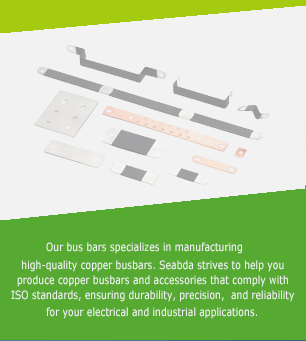
Ihr führender Hersteller von Sammelschienen aus vernickeltem Kupfer
Als führender Hersteller ist unser Werk auf die Herstellung hochwertiger vernickelter Kupfersammelschienen für eine effiziente und zuverlässige Stromverteilung spezialisiert. Unsere Kupfersammelschienen werden aus hochreinem Kupfer hergestellt und mit einer haltbaren Nickelschicht überzogen. Sie sind darauf ausgelegt, den hohen Anforderungen verschiedener industrieller und kommerzieller Anwendungen gerecht zu werden.
Production Process of nickel plate copper bus bar:
1. Copper wire preparation:
Adopt high-purity electrolytic copper through drawing and stranding processes to process it into the required diameter of copper wire, with tolerance control within ± 0.005mm.
2. Surface treatment:
Copper wire by ultrasonic cleaning and acid washing (such as with sulfamic acid) to remove surface oil and oxides.
3. Electroplating nickel layer:
Adopt the electroplating or chemical plating process, and control the current density (2-5A/dm²), temperature (50-60℃) and pH (3.5-5.5) to form a uniform and dense nickel layer.
4. Post-treatment:
Annealing to eliminate internal stress, ultrasonic cleaning to remove residues, drying and testing of coating thickness, bonding force, and other indicators.
5. Quality Inspection:
The use of high-precision instruments to detect the conductivity, plating uniformity, and corrosion resistance (such as salt spray test).
Warum werden Sammelschienen vernickelt?
1. Corrosion resistance:
Nickel in the humid, salt spray environment can form a passivation film, preventing oxidation of the copper substrate, prolonging the life of the busbar.
2. Reduce contact resistance:
The nickel layer has a smooth surface, which reduces the roughness of the contact surface and avoids the elevated resistance caused by oxidized copper and improves the efficiency of current transmission.
3. Abrasion resistance:
Nickel hardness (HV200-300) is much higher than copper (HV40-60), suitable for sliding contact scenarios (e.g. drawer cabinet connectors).
4. Solderability:
The nickel plating layer is stable at high temperature, superior to tin plating (easy to produce tin whiskers), and suitable for high-frequency welding processes.

Wofür wird vernickeltes Kupfer verwendet?
With its high electrical conductivity, corrosion resistance, and abrasion resistance, nickel-plated copper is widely used in electronic communications, new energy, industrial manufacturing, and other fields: in electronic communications, it is used in 5G equipment, high-frequency circuit boards, and precision sensors to ensure the stable transmission of signals; in the new energy automotive and photovoltaic industries, it is used as a battery connector and high-voltage conductor to adapt to high temperatures, salt spray, and other harsh environments; and it is used for abrasion-resistant mechanical parts and chemical pipelines to resist friction and cost in the industry.
With the development of 5G, electric vehicles, and other industries, the application of nickel-plated copper will continue to expand in scenarios that require high conductivity and durability.
Ist vernickeltes Kupfer besser als Kupfer?
Als Hersteller wissen wir, dass die Eignung von vernickeltem Kupfer gegenüber blankem Kupfer von den spezifischen Anwendungsanforderungen abhängt. Vernickeltes Kupfer bietet im Vergleich zu blankem Kupfer Vorteile in Bezug auf verbesserte Korrosionsbeständigkeit, Oxidationsschutz und verbesserte Haltbarkeit. Diese Vorteile machen vernickeltes Kupfer besonders geeignet für Anwendungen, bei denen mit rauen Umgebungen, korrosiven Substanzen oder längerer Nutzung zu rechnen ist. Blankes Kupfer kann jedoch in Anwendungen vorzuziehen sein, bei denen Kosteneffizienz oder minimaler elektrischer Widerstand im Vordergrund stehen. Letztendlich hängt die Wahl zwischen vernickeltem Kupfer und blankem Kupfer von Faktoren wie Umgebungsbedingungen, Leistungserwartungen und Budgetbeschränkungen ab.
| Characteristics | Nickel-plated copper | Pure copper |
|---|---|---|
| Electrical Conductivity | Slightly lower (higher nickel resistivity) | Excellent (conductivity ≥100% IACS) |
| Korrosionsbeständigkeit | Excellent (resistant to oxidation, acids and alkalis) | Medium (easily oxidized to produce copper green) |
| Mechanical Strength | Hoch | Medium |
| Environment | High humidity, high salt spray, high temperature | Dry, non-corrosive environment |
| Costs | Hoch | Niedrig |

 German
  English
  Arabic
  Spanish
  French
  Russian
  Danish
  Japanese
  Italian
  Vietnamese
  Turkish
  Dutch
Dutch  Portuguese
  Thai
Thai  Swedish
  Korean
  Greek
Greek  Polish
  Estonian
  Esperanto
  Hindi
Hindi  Indonesian
  Latvian