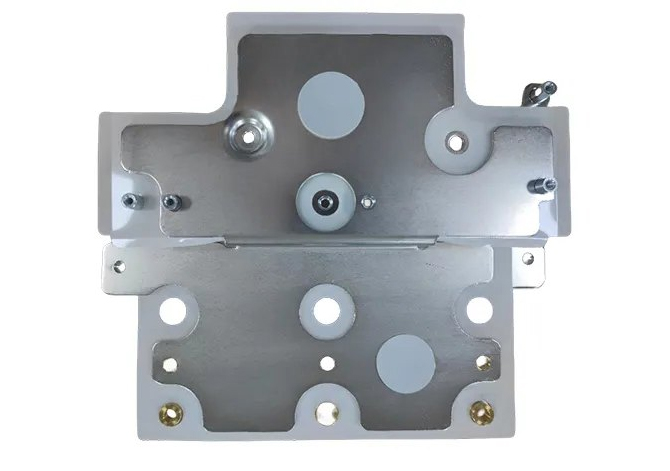
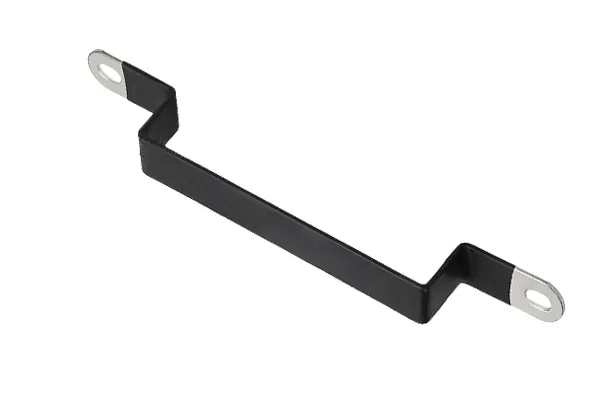
Kundenspezifische Sammelschiene aus verzinntem Kupfer
√ Kupferadern sorgen für eine effiziente Stromverteilung.
√ Verbessert die elektrische Leistung.
√ Widersteht Verschleiß und mechanischen Beschädigungen.
√ Ideal für Stromverteilung, Schaltanlagen und mehr.
√ Erfüllt die Branchenstandards für Qualität und Zuverlässigkeit.
Our factory tin plated copper bus bars are engineered to deliver exceptional conductivity, corrosion resistance, and longevity. Covered with a tin layer on the surface of a pure copper busbar through electroplating or a hot plating process, which is widely used in electric power systems, new energy equipment, rail transportation, communication base stations, and other fields. Its core advantage is that it combines the high conductivity of copper with the corrosion resistance of tin and is suitable for high-current transmission and high-frequency signal shielding scenarios.
| Artikeltyp: | verzinnte Kupfersammelschiene |
|---|---|
| Materialbasis: | Kupfer (C11000 oder C10100) |
| Beschichtung: | Zinn (matt oder glänzend) |
| Breite: | 10 mm bis 200 mm |
| Dicke: | 2 mm bis 20 mm |
| Länge: | Anpassbar, normalerweise bis zu 6 Meter |
| Leitfähigkeit: | ≥ 98% IACS (Internationaler Standard für geglühtes Kupfer) |
| Widerstand: | Geringer Übergangswiderstand durch Verzinnung |
| Zugfestigkeit: | 200–400 MPa (je nach spezifischer Legierung und Härte) |
| Verlängerung: | 30-40% (abhängig von der jeweiligen Legierung und Härte) |
| Härte: | 40-80 HV (Vickershärte) |
| Dicke der Zinnbeschichtung: | 3 bis 15 Mikrometer (anpassbar) |
| Korrosionsbeständigkeit: | Hervorragend, dank der Zinnbeschichtung |
| Betriebstemperatur: | -55°C bis +105°C (geeignet für die meisten elektrischen Anwendungen) |
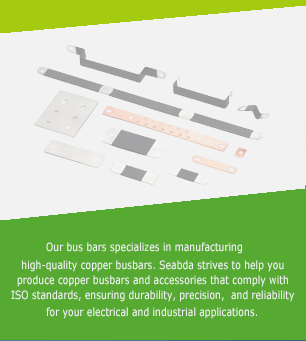
Führender Hersteller von verzinnten Kupfersammelschienen
Unsere Fabrik ist auf die Herstellung hochwertiger verzinnter Kupfersammelschienen spezialisiert. Unsere Produkte zeichnen sich durch verbesserte Korrosionsbeständigkeit, hervorragende elektrische Leitfähigkeit und verbesserte Lötbarkeit aus. Mit anpassbaren Abmessungen und der Einhaltung von ISO- und Industriestandards gewährleisten wir zuverlässige und langlebige Sammelschienen für eine breite Palette von elektrischen und industriellen Anwendungen. Vertrauen Sie auf uns, denn jede Sammelschiene, die wir produzieren, bietet überragende Leistung und außergewöhnliche Qualität.
Parameter
1. Electrical performanc
- Rated current: 250A to 5000A (adjusted according to cross-section and wire diameter).
- Conductivity: Tinned copper purity ≥ 99.95%, resistivity ≤ 0.01777 Ω-mm²/m (hard state).
- Voltage withstand level: frequency withstand voltage 42kV (dry test), impact withstand voltage 75 kV.
2. Physical Characteristics
- Single wire diameter: 0.05mm to 0.30mm (braided); cross-section range 1.5-6000mm².
- Thickness of tin plating: usually 0.5-2.0 μm (conventional plating), special requirements up to 6 μm or more.
- Mechanical strength: hard state busbar tensile strength ≥200N/mm², soft state elongation ≥35%.
3. Anpassungsfähigkeit an die Umwelt
- Temperature range: -30℃ to 105℃, some high-temperature-resistant models can reach 200℃.
- Protection grade: IP54 (dustproof and waterproof).
Wie verzinnt man Kupfersammelschienen?
1. Copper pretreatment
- Drawing and annealing: High purity copper rods are drawn to the target wire diameter, and the annealing temperature is controlled at 400-550°C to optimize the ductility.
- Acid washing to remove oxidized layer: Use acidic solution (such as hydrochloric acid or flux) to remove surface oxides to ensure plating adhesion.
2. Tin plating process
- Hot-dip plating/electroplating: Copper wires are immersed in a tin furnace (250-260°C) or electroplating bath to form a uniform plating layer. Cooling and cleaning: Water or air cooling is used to remove the surface oxides.
- Cooling and Cleaning: After water or air cooling, clean the residue, add shaft guide oil to prevent the generation of tin ash.
3. Post-treatment and inspection
- Annealing: 600-800℃ annealing to eliminate stress and improve flexibility.
- Quality inspection: including conductivity test, plating thickness measurement (such as X-ray fluorescence method) and corrosion resistance test.
Wie dick ist die verzinnte Kupfersammelschiene?
- Conventional applications: 0.5-2.0μm, balancing cost and performance.
- High protection requirements: such as power equipment or marine environment, the thickness of the coating can be more than 6μm.
Warum Verzinnung von Kupfersammelschienen?
Die Verzinnung von Kupfersammelschienen dient mehreren Zwecken. Erstens verbessert sie die Korrosionsbeständigkeit des Kupfers, verlängert seine Lebensdauer und gewährleistet eine langfristige Leistung, insbesondere in feuchten oder korrosiven Umgebungen. Zweitens sorgt die Verzinnung für eine glattere Oberflächenbeschaffenheit, reduziert Oberflächenunregelmäßigkeiten und verbessert den elektrischen Kontakt und die Leitfähigkeit. Darüber hinaus kann die Verzinnung die Oxidation der Kupferoberfläche verhindern und so ihre Integrität und elektrischen Eigenschaften im Laufe der Zeit bewahren. Insgesamt bietet die Verzinnung eine verbesserte Haltbarkeit, Leitfähigkeit und Zuverlässigkeit für Kupfersammelschienen in verschiedenen Anwendungen.
Verzinnte Kupfersammelschienen bieten mehrere Vorteile:
1. Anti-oxidation and corrosion resistance
- The tin layer isolates copper from oxygen and moisture, avoiding the generation of copper green (Cu₂(OH)₂CO₃) with poor electrical conductivity, and prolonging the life of the busbar.
2. Improve conductive stability
- Tin plating reduces contact resistance (by about 10-15%), especially in high-frequency or high-current scenarios to reduce energy loss.
3. Enhanced solderability
- Tin has a low melting point (232°C), which makes solder joints easier to form and stronger, making it suitable for automated soldering processes.
4. Adapt to complex environments
- Resistant to salt spray, acid and alkali, suitable for chemical, marine and other corrosive environments.
5. Economy and environmental protection
- Compared with pure silver plating, tin plating cost is lower, and tin non-toxic in line with RoHS standards.
Tin-plated copper bus bars application:
- Power system: transformer, switchgear connection, extra high voltage transmission.
- New energy vehicles: battery pack connection, charging pile internal conductor.
- Communication equipment: 5G base station, data center high frequency signal shielding.

 German
  English
  Arabic
  Spanish
  French
  Russian
  Danish
  Japanese
  Italian
  Vietnamese
  Turkish
  Dutch
Dutch  Portuguese
  Thai
Thai  Swedish
  Korean
  Greek
Greek  Polish
  Estonian
  Esperanto
  Hindi
Hindi  Indonesian
  Latvian